Many firms are looking beyond local hiring to solve this. Offshoring accounting work lets CPA firms tap skilled talent overseas, control costs, and flex capacity during tax season without compromising quality.
This guide covers what offshoring actually means, its real benefits and challenges, how to build a strategy, and what to look for in a partner.
Key Takeaways
- Tap global talent pools like India to cut costs and ease the domestic accountant shortage
- Control, integration, and dedicated staffing set offshoring apart from traditional outsourcing
- Vet partners for US GAAP fluency, data security protocols, and workable time-zone overlap
- Phase rollout from bookkeeping to reviews to advisory to reduce onboarding risk
What Is Offshoring Accounting for CPA Firms?
Offshoring means delegating accounting or tax functions to professionals based in another country. Firms typically choose one of two paths:
- Dedicated-hire model: You select and manage offshore staff who work exclusively on your accounts, giving you more control over quality and workflow
- Third-party firm model: An offshoring partner manages delivery, staffing, and quality control, and you receive completed deliverables
The distinction matters because it changes who's accountable for daily supervision versus final results.
Either model is moving into the mainstream. According to a 2024 AICPA-cited survey in the Journal of Accountancy, roughly 25% of firms already offshore, and another 12% plan to start. With fewer accounting graduates entering the pipeline, that trend line makes sense.

Offshoring vs. Outsourcing vs. Nearshoring
These terms get used interchangeably, but they're not the same thing.
- Outsourcing is any third-party delegation — it can be domestic or international
- Offshoring specifically means international delegation, whether through dedicated hires or pooled staff
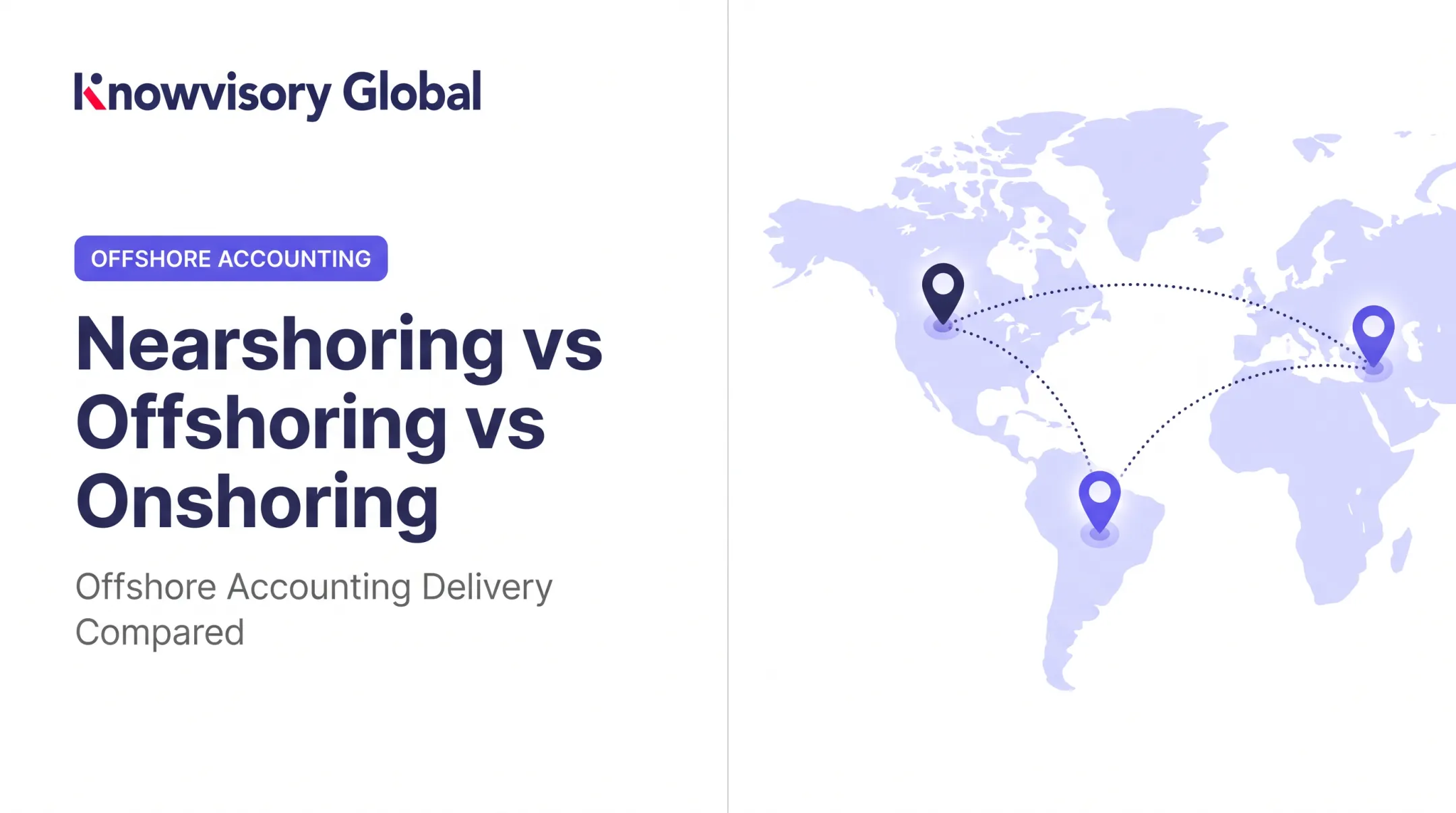
- Nearshoring is a time-zone-aligned subset of offshoring, typically to Latin America
The time-zone math matters here. Colombia shares US Eastern time exactly; Mexico is within a few hours. India, by contrast, runs 9.5 to 13 hours ahead depending on your US time zone, per Howdy's 2025 research on global hiring. The tradeoff: India offers a much larger pool of credentialed accounting talent.
Benefits of Offshoring Accounting for CPA Firms
Cost Savings That Actually Add Up
A US bookkeeper's fully loaded annual cost (salary, payroll taxes, benefits, training, software, office space) typically runs $75,700 to $109,100 in metro markets, according to internal cost modeling from offshore accounting providers.
Offshore rates start around $7.50–$20 per hour, or roughly $14,250 to $38,000 annually on a comparable hours basis. That's not a marginal difference. It's the gap between hiring one person and building a team.
On the talent side, India's Chartered Accountant pipeline is enormous. The ICAI reported nearly 8,000 newly qualified CAs placed across 241 companies in its late-2024 campus drive alone, with an average starting salary around ₹12.49 lakh (roughly $14,900).
Compare that to a US accountant's median pay of $83,680/year per BLS data.

Specialized Talent, Not Just Cheap Labor
Beyond lower cost, firms gain credentialed expertise. KnowVisory Global staffs engagements with both US CPAs and Indian CAs, pairing technical depth with US regulatory fluency. That dual structure means work is checked against both standards, not just one.
Scaling Through Tax Season Without Permanent Headcount
Q1 and Q4 crunches don't require permanent hires when you have offshore flex capacity. One documented case: an Illinois accounting firm expanded bookkeeping capacity in under three weeks, cutting delivery costs by 55% with zero disruption to existing clients.
Other advantages include:
- Shifts payroll, HR, and compliance overhead to the offshoring partner
- Frees onshore staff from routine compliance for higher-value advisory work
- Pairs skilled staff with AI for anomaly detection and faster reporting cycles
Challenges of Offshoring Accounting (and How to Mitigate Them)
Offshoring adds capacity, but four friction points show up repeatedly for CPA firms. Each has a practical mitigation if you set expectations before kickoff.
Time Zone Gaps
India's 9.5-13 hour gap leaves little natural overlap with US business hours. Establish daily "golden hours" (even a 1-2 hour window for live collaboration) and rely on overnight processing so finished work is ready before your team logs on.
Communication and Cultural Differences
English proficiency varies by individual, not just by country. Mitigate this with:
- Clear, written SOPs instead of verbal-only instructions
- Recorded training sessions staff can replay
- Structured status updates with defined response-time expectations
Data Security and Compliance Risk
This is where firms should be most careful. Before signing with any offshore partner, verify:
- SOC 2 compliance or equivalent security certification
- Signed NDAs covering all staff with data access
- Role-based access controls limiting exposure to only necessary data
- Written client consent for IRS-related disclosures, as required under IRC §7216
Note: not every offshore provider publishes detailed security certifications upfront. Ask directly, and don't assume compliance without documentation.
Quality Control and Standards Alignment
Don't assume a foreign accounting credential equals US GAAP fluency. Confirm the team has hands-on training in:
- US GAAP and the IRS forms your clients actually file
- Your firm's software stack (QuickBooks, NetSuite, Sage Intacct, or equivalent)
- Your review notes, workpaper standards, and turnaround SLAs

How to Build an Offshoring Strategy for Your CPA Firm
A workable offshoring strategy is built in stages.
- Audit your technology first. Confirm your cloud tools support remote collaboration before you hire anyone: QuickBooks, secure client portals, and practice management software.
- Start with lower-risk functions. Begin offshoring bookkeeping, data entry, and tax return preparation. Move to review-level work only once trust is established.
- Pick a model that fits your volume. Match the engagement model to your workload:
- Dedicated staff for steady year-round work
- Project-based support for seasonal spikes
- Hybrid when you need both
- Document a structured onboarding plan. A 60-day framework covering SOPs, system access, parallel processing, and quality-control scoring reduces surprises and can hold the monthly error rate below 0.4%.

Don't skip the parallel-run phase. Running offshore work alongside your existing process for a few weeks before full handoff catches gaps before they become client-facing problems.
Choosing the Right Offshoring Partner
Not all offshore partners are structured the same way, and that structure affects your risk exposure.
When you evaluate partners, pressure-test these three areas:
- Dual-credentialed teams with US CPAs and Indian CAs that review work against US standards, not just technical competence (KnowVisory Global's model)
- Scope-based pricing quoted upfront, with advance approval outside scope, instead of hourly billing that produces surprise invoices
- Real references with documented US tax deadline experience you can verify
One multi-state CPA firm partner e-filed more than 500 tax extensions in a single day during peak season. Another cleared an 18-month bookkeeping backlog across 22 businesses in 90 days, hitting the October 15 extended deadline with zero late filings.
That pressure-tested performance is what matters during your own busy season.
Frequently Asked Questions
What does offshore accounting mean?
Offshore accounting means delegating financial and accounting tasks to professionals in another country to cut costs and access specialized talent at rates hard to match locally.
Is there a difference between offshoring and outsourcing?
Yes. Outsourcing is any third-party delegation, domestic or international. Offshoring specifically means international delegation, which can be structured as dedicated hires or pooled staff.
What accounting functions can a CPA firm safely offshore?
Bookkeeping, tax preparation support, accounts payable/receivable, and financial reporting are commonly offshored. Most firms start with lower-risk, high-volume tasks before moving to review-level work.
Is offshoring accounting work for a CPA firm legal and compliant?
Yes, when firms follow AICPA confidentiality rules, obtain proper client consent per IRC §7216 for tax data, and verify state board disclosure requirements. Requirements vary by state, so check your board's current guidance.
How much can a CPA firm save by offshoring accounting tasks?
Savings can reach up to 60% versus an in-house team once you factor in recruitment, benefits, and overhead. Many firms see the largest gains on high-volume bookkeeping, AP/AR, and tax support work.
How do I ensure data security when offshoring accounting work?
Require SOC 2 compliance or equivalent certification, signed NDAs, role-based access controls, and written client consent for any tax-related disclosures under IRC §7216 before sharing sensitive financial data.