2026 is called the ‘tax reset’ year. With certain TCJA provisions expiring, new federal tax rules coming into effect, and IRS reporting requirements shifting, businesses are going to face a complex April filing season this year. Understanding 2026 tax changes for businesses is essential, as with all the ongoing modifications, companies can no longer rely on last-minute tax preparation.
Get your books in order now, if you haven’t done so yet, and understand the key tax changes to save thousands of dollars in taxes. It will also set you up for smarter, financially strong 2026.
Key Tax Changes Impacting Businesses This Filing Season
1. 100% Bonus Depreciation is Back, and Has Been Made Permanent
Thanks to the One, Big, Beautiful Bill (OBBB), bonus depreciation has been permanently fixed to 100%. This means that any qualified asset purchased and placed in service after January 19, 2025, may now be fully eligible for this deductibility. So, if you have bought business equipment, software, or machinery last year, you can use this deduction to drastically reduce your taxable income.
2. QBI Deduction Has Been Made a Permanent Part of Pass-Through Entities
One of the biggest 2026 tax law updates of US is that the 20% Qualified Business Income (QBI) deduction, also known as the Section 199A deduction, has been made a permanent part of the tax code for sole proprietors, partnerships, and S-Corps.
However, the eligibility for the QBI deduction depend on your total taxable income and the type of business you have. So, if your taxable income is below a certain threshold ($197,300 for single filers; $394,600 for MFJ), you can take the full 20% deduction without limitations as per your business type or the amount of W-2 wages and qualified property.
However, if your taxable income exceeds these thresholds, limitations may apply. So, make sure your 2025 income, wages, and business deductions are accurately tracked to maximize this benefit. For expert help, reach out to a qualified tax professional today.
3. Business Interest Deduction
As per US business tax changes 2026, the rules for deducting business interest are now based on EBITDA rather than EBIT. This allows more interest to be deducted for businesses with loans or financing. If your company had debt in 2025, this could reduce your tax liability and improve cash flow, especially if you are in a capital-intensive industry.
4. 1099-K Reporting Threshold Has Changed
For small businesses and e-commerce sellers, the 1099-K reporting threshold has been permanently raised to $20,000 and 200 transactions per year for third-party settlement organizations (TPSOs). This reduces unnecessary reporting burdens and lowers the risk of IRS notices caused by over-reporting smaller payments.
5. Other Retroactive Changes Affecting 2025 Returns
Some provisions of OBBB would apply retroactively, too and would affect the returns you file this April:
- No tax on tips (up to $25,000 per taxpayer, with income limits)
- No tax on overtime (up to $12,500, with income limits)
- Increased Child Tax Credit to $2,200 per qualifying child (indexed for inflation)
- Adoption credit now partially refundable, up to $5,000
All these retroactive changes mean your 2025 books must be accurately reconciled to avoid missing deductions or triggering audits.
Important April 2026 Deadlines for Businesses
| Deadline | Filing / Payment |
| Jan 15, 2026 | Q4 2025 Estimated Taxes |
| Jan 31, 2026 | W-2, W-3, 1099 filings |
| Mar 16, 2026 | Partnership (Form 1065) & S-Corp (Form 1120-S) due |
| Apr 15, 2026 | Individual & C-Corp tax returns due; Q1 2026 Estimated Tax Payment |
Tip: Filing extensions give more time to submit forms, not to pay taxes. Avoid last-minute penalties by planning payments ahead.
What’s New This Tax Season?
According to the IRS, below are some important new provisions and tax forms taxpayers and preparers should be aware of this season:
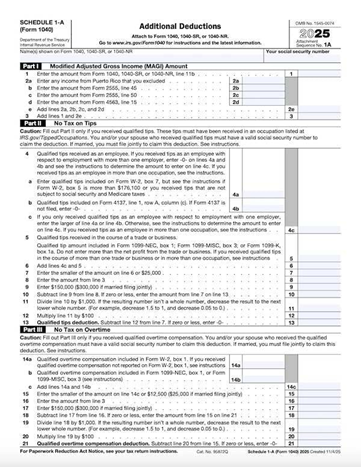
1. New Schedule 1-A
A new IRS form, Schedule 1-A, has been introduced by the IRS to help taxpayers claim the recently introduced deductions. These include:
- No tax on tips
- No tax on overtime pay
- No tax on car loan interest
- Enhanced deduction for seniors
This schedule must be attached to Form 1040 to report these newly allowable adjustments.
2. Trump Account Enrolment
A new provision allows parents, guardians, or authorized individuals to establish a Trump Account
3. Form 1099-K
This form has been reinstated with a higher reporting threshold (permanent rule). Form 1099-K can be used by e-commerce sellers, freelancers, and gig workers to accurately report business income received from:
- Credit card transactions
- Third-party payment apps
- Online marketplaces
4. Form 1099-DA — Digital Asset Transactions
Form 1099-DA is used to report proceeds from digital asset transactions from brokers and other marketplaces. If you have digital asset sales or transactions in 2025, this form may apply.
Strategic Tips for This Filing Season
Here are some tips that can help you stay ahead of 2026 tax changes for businesses:
Reconcile 2025 Accounts Now
Make sure your books are accurate and up to date, with all income, expenses, and deductions properly registered. Any overlooked item could cost you deductions or create audit issues.
Gather all income documents early
Collect your W-2s, 1099s, and bank statements before you start. Missing even one form can delay your return or cause IRS notices later.
Check your numbers against last year
Compare income, deductions, and tax paid with last year’s return. Are there major changes? Have you missed out on something or reported it twice?
Track deductions carefully
Keep receipts for business expenses, medical costs, charitable donations, and education expenses. Organized records mean fewer mistakes and bigger savings.
Review your filing status
Life changes like marriage, divorce, or a new child can change how you should file—and how much tax you owe or save. Connect with your tax advisor for expert support.
Don’t forget credits
Credits for children, education, energy upgrades, and health insurance can significantly reduce your tax bill. Make sure to take benefits of all available and applicable credits.
File electronically and use direct deposit
E-filing reduces errors and ensures quicker refunds. Similarly, direct deposit helps you get your money quickly and more securely.
Plan how you’ll pay
How much taxes do you owe? Can you pay in full? If not, use IRS’s payment plan options to spread out your payments and avoid penalties.
Start Now—April Waits for No One.
Remember, businesses that reconcile their books on time, maximize deductions, and optimize their tax strategy can not only reduce their liability but also avoid penalties.
At KnowVisory Global, we help U.S. businesses prepare for every tax season with confidence. With proactive and actionable guidance, we ensure your filings are accurate, timely, and tax efficient. So, partner with us and file your taxes accurately and on time. Book your consultation now!