Running an e-commerce business looks pretty easy. You list products, ship orders, and collect payments. But in reality, it’s a complex puzzle with dozens of moving pieces – numerous sales channels, moving inventory, multi-currency payments, and a long list of expenses to track. Without a proper accounting system, it’s almost impossible to manage back-office operations.
The good news? Setting up an efficient accounting system isn’t difficult. All you need is the right structure, tools, and some professional accounting support.
In this blog, we list everything you need to build a global accounting system that keeps your e-commerce finances clean, compliant, and easy to manage.
1. Start With a Clear Chart of Accounts
A chart of accounts is a categorized list of everything your business earns, owns, and spends. It is the backbone of your entire accounting system.
For e-commerce, a basic chart of accounts typically includes:
| Assets Bank accounts Inventory Accounts receivable Prepaid expenses Equipment and furniture | Liabilities Sales tax payable Accounts payable Credit card balances Short-term loans |
| Income Product sales Shipping income Platform fees reimbursed Other operating income | Expenses Merchant processing fees Shipping & fulfillment Advertising (Facebook, Google, Amazon PPC) Website and app subscriptions Freelancer or employee payments Packaging materials |
A well-structured chart of accounts makes bookkeeping 10x easier because every transaction automatically finds its place. It helps prevent duplicate categories, mismatched numbers, and a huge headache during tax season.
2. Choose the Right Accounting System
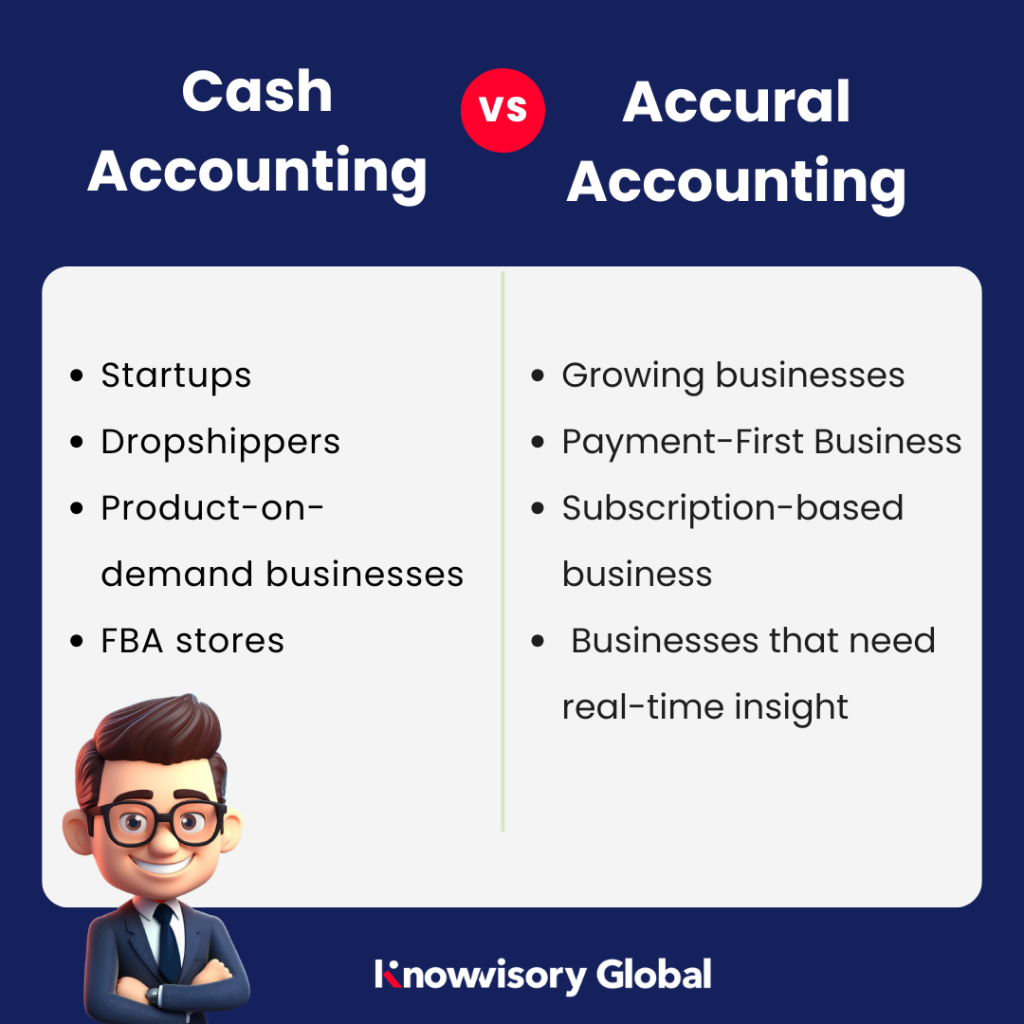
Choosing the right accounting system – cash accounting versus accrual accounting – can save you hours of stress later. Cash accounting is simple – you record money only when it actually comes in or goes out. Most small e-commerce sellers start here because it’s easy to manage. Accrual accounting, on the other hand, records income and expenses when they happen, not when the cash moves. It gives you a clearer picture of your real profitability, especially if you deal with inventory, pre-orders, or delayed payouts. Once you know which method fits your business, choosing software becomes much easier, and your books stay accurate from day one.
3. Automate As Much As Possible
E-commerce accounting often starts on spreadsheets. But as your business grows, you need automated accounting software that automatically integrate with your sales channels, handle multi-currency transactions and conversions, and effortlessly sync with payment gateways.
QuickBooks Online, Xero, NetSuite, SAP Business One, and Zoho Books are some of the popular options.
Remember, your business might be small today, but building an automated setup early helps you scale with confidence.
Pro Tip: Automate your bookkeeping processes to reduce manual work. It saves you time, reduces human error, and keeps your books cleaner.
4. Integrate Your Sales Channels, Payment Gateways & Banks
Your accounting system should seamlessly talk to your e-commerce platforms. From Shopify to Magento and from Stripe to Razorpay, it must integrate everything together.
When everything is synced automatically, your books stay consistent. You also eliminate the risk of missing income or forgetting to record fees.
5. Set Up a Proper Inventory Tracking Method
Inventory affects cash flow as well as your profit margins. Yet, many online sellers treat inventory casually. To stay sorted, build an efficient accounting system that tracks everything – units purchased, units sold, cost of goods sold (COGS), inventory on hand, and inventory value.
Three common inventory accounting methods are mostly used:
- FIFO (First In, First Out) – best for fast-moving products
- LIFO (Last In, First Out) – used mostly for tax strategy (U.S.)
- Weighted Average – simple for stores with lots of SKUs
6. Track Your Cost of Goods Sold Correctly
COGS is the biggest number that affects your profit. If you are not tracking it correctly, you’ll never be able to know your real margins.
COGS includes:
- Raw material used to create a product/ perform a service
- Labor used to develop a product / perform a service
- Overhead costs of production
Many e-commerce owners make the mistake of counting only the product price and ignoring additional expenses. This leads to overestimated profits and poor pricing decisions.
A clean COGS system is essential if you want to scale.

7. Establish a Clean Sales Tax Process
Sales tax is one of the most confusing parts of running an e-commerce business. Especially in the U.S., where tax rules vary from one state to another.
Adopt a global accounting system that accurately captures your customers’ location, taxes collected per transaction, marketplace-collected tax, if any – and calculate taxes that you need to file.
A proper accounting system ensures you charge the correct tax rate and stay compliant with state as well as federal tax laws.
8. Keep Personal and Business Expenses Separate
Mixing personal and business money is the best way to create accounting chaos – not to forget the tax-time nightmare it creates.
To stay sorted, set up a dedicated business bank account and a separate UPI/wallet account. It helps you track expenses more clearly and maintain accurate cash flow reports.
9. Perform Monthly Reconciliations
Make sure to reconcile your transactions every month. This includes checking:
- Bank statements
- Marketplace payout reports
- Payment processor reports
- Inventory counts
Monthly reconciliation helps you catch missing transactions, duplicate entries, missing fees, and misreported sales
10. Track Your Key Financial Metrics
Your accounting system isn’t just for compliance—it should help you understand the health of your business. Here are the key financial metrics every us business owner should track.
By tracking these financial metrics consistently, you can make smarter decisions about pricing, marketing, and inventory.
11. Work With a Professional Accounting Service Provider
E-commerce accounting gets messy faster than most people expect. Once you start dealing with multiple products, different payment apps, refunds, shipping costs, and taxes from different states, the numbers can get out of hand pretty quickly.
That’s why having someone who actually understands the backend—an accountant or a bookkeeping team—can save you a lot of stress. They’ll set things up the right way, clean up the chaos, automate the boring stuff, and give you numbers you can trust. It means fewer headaches for you and more time to actually grow your store.
At the end of the day, a solid accounting setup isn’t a “nice to have” for e-commerce. It’s the thing that keeps everything else running smoothly. With the right tools and the right people supporting you, handling your books becomes much easier.