There are 36.2 million small businesses in the USA. But did you know out of these only 9% small businesses reach $1 million (or more) in revenue?
Crossing the seven-figure threshold is a major milestone. But scaling past this figure requires more than just grit — it demands rigorous financial visibility. At this stage, revenue can no longer be the only metric that matters. Revenue is a lagging indicator that tells you what has already happened, and not what’s about to happen or what you can fix.
Fast-growing companies need targeted FP&A KPI reporting. Without it, businesses are always at risk of experiencing “profitless growth”, where sales skyrocket but actual profitability plummets.
To scale sustainably from a seven-figure business into a high-performing growth company, leaders need visibility into the financial and operational metrics that drive long-term success. This guide outlines the 10 essential KPIs every US business generating over $1 million in revenue should track monthly via a centralized business KPI dashboard.
Think of it as your bookkeeping handoff guide for scaling confidently.
Financial KPIs for Small Business, USA
KPI #1: The Cash Conversion Cycle (CCC)
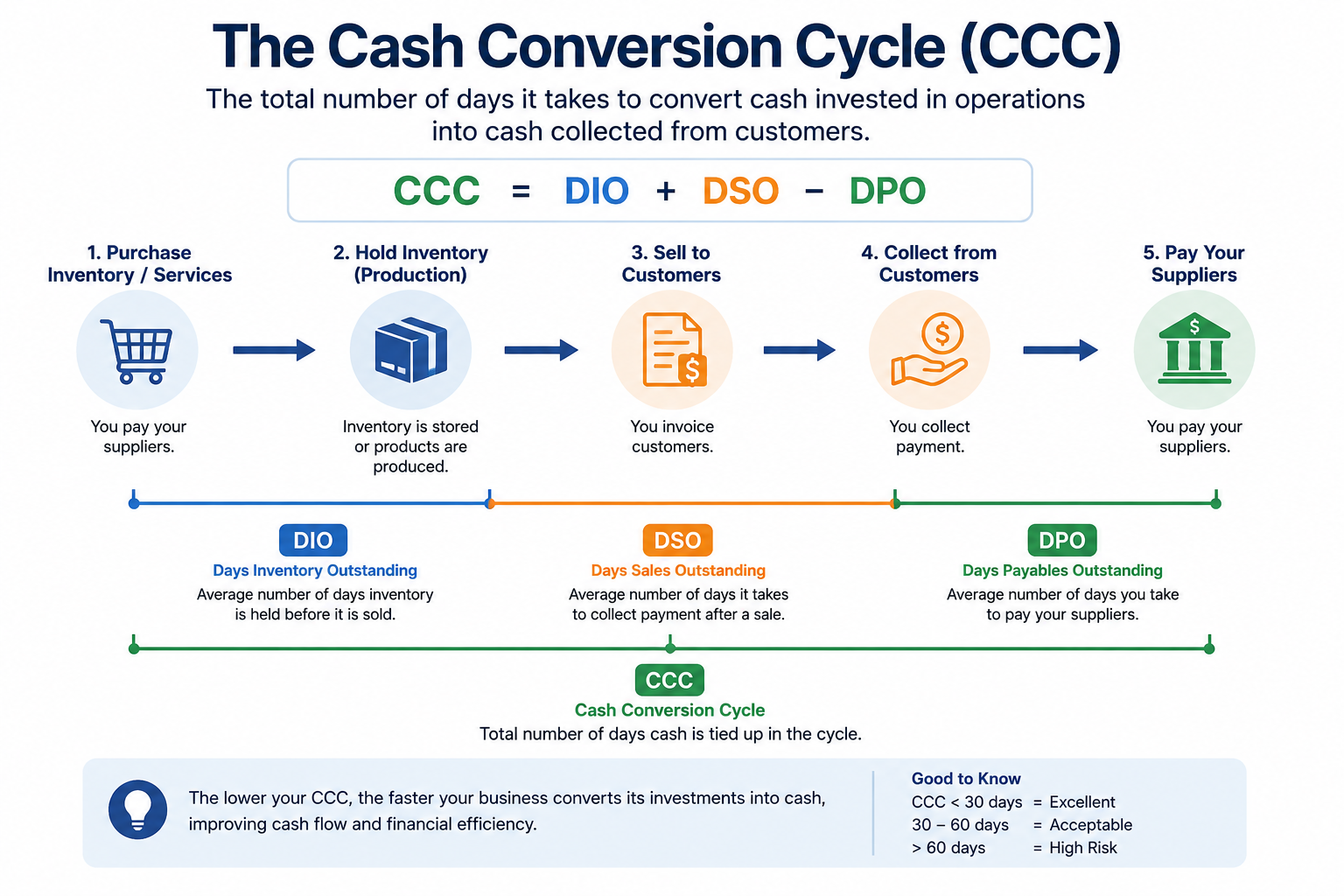
The CCC measures the exact number of days your cash stays tied up in your operations – from the moment you pay suppliers for inventory or services until you collect payment from customers. It provides a clear view of how efficiently your business converts its investments into cash and helps identify opportunities to improve liquidity and working capital management.
CCC = Days Inventory Outstanding (DIO) + Days Sales Outstanding (DSO) – Days Payables Outstanding (DPO)
Why It Matters: A lower CCC means you free up cash quickly. A negative CCC is ideal because it means customers pay you before you have to pay your suppliers.
Target Benchmark:
- Under 30 Days: Excellent cash velocity.
- 30-60 days: Acceptable
- Over 60 Days: High risk. You are effectively financing your clients’ businesses.
How to Improve It:
- Secure upfront payments
- Transition accounts to automated credit card or ACH billing
- Reduce on-hand inventory levels
- Negotiate longer payment windows (Net-45 or Net-60) with major vendors
KPI #2: Working Capital Ratio (Current Ratio)
It measures whether the business has enough short-term assets to cover short-term obligations.
Working Capital Ratio = Current Assets / Current Liabilities
Why It Matters: A profitable business can still fail if it runs out of cash. The Working Capital Ratio helps assess liquidity and indicates whether the company can comfortably meet its short-term obligations.
Target Benchmark:
- 1.5 – 2.0: Healthy
- Above 2.0: Strong liquidity
- Below 1.0: Warning sign; liabilities exceed liquid assets
How to Improve It: Accelerate receivables collections, reduce unnecessary inventory, negotiate longer vendor payment terms, improve cash flow forecasting, and refinance short-term debt into longer-term obligations.
KPI #3: Revenue Concentration Index (RCI)
Revenue Concentration Index (RCI) measures how dependent your business is on a small number of customers for revenue. It helps businesses assess customer concentration risk. Overreliance on a few large clients can create cash flow uncertainty and limit long-term stability.
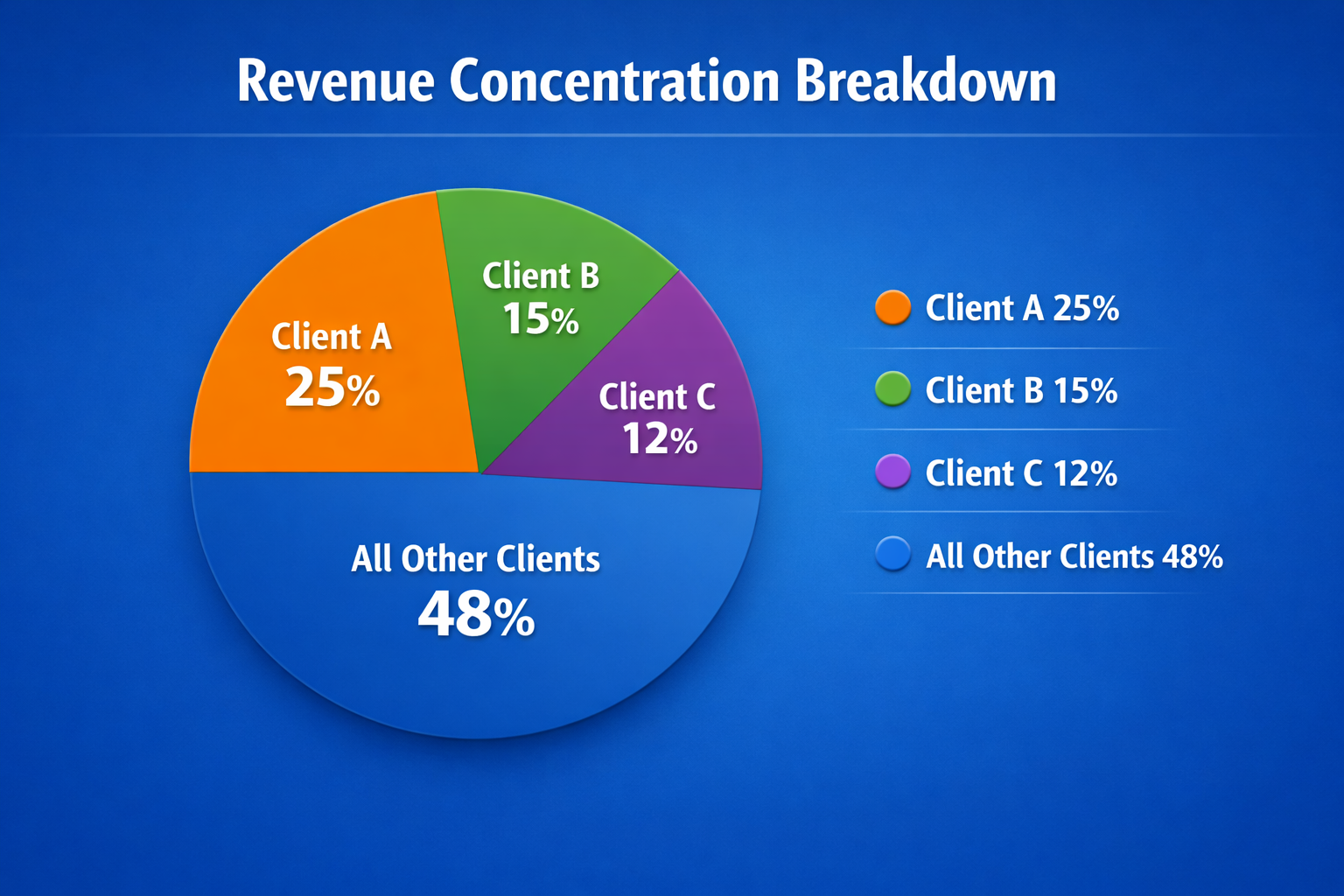
For example, if 50-60% of your revenue comes from two or three customers, your RCI would indicate a high concentration risk. Losing either customer could have a significant impact on revenue and profitability.
RCI=(Aggregate Revenue from Top 3 Clients /Total Corporate Revenue )×100
Why It Matters: A high RCI indicates that a significant portion of revenue comes from a limited customer base.
Target Benchmark:
- Below 20%: Healthy, secure diversification.
- 20% to 30%: Acceptable but requires close monitoring.
- Above 30%: Material risk. Acquirers and investors will heavily discount your company’s valuation.
How to Improve It: Avoid custom work for mega-accounts that consumes all your staff’s energy. Systematize delivery so you can smoothly scale up and acquire 10 to 15 smaller, diversified accounts.
KPI #4: Unit Economics Efficiency Ratio (UEER)
UEER measures the direct relationship between the gross profit a single customer generates and the total financial cost required to acquire, onboard, and support them through their initial lifecycle.
UEER = Gross Profit Margin Per Customer / Fully Loaded Cost to Acquire, Onboard, and Serve Customer (First 90 Days)
Why It Matters: UEER strips away top-line revenue and highlights the real operational cost of customer acquisition. It shows whether each additional customer is driving profitable growth or simply increasing operational complexity and costs
The Target Benchmark:
- 3:1 or higher: Premier efficiency. You are building compounding leverage.
- 2:1 to 3:1: Stable, but optimization is required.
- Below 2:1: Red line. You are effectively buying revenue at a loss.
How to Improve It: Tighten your customer onboarding workflow to reduce manual labor, increase front-end pricing, or narrower your customer targeting to high-margin client profiles.
KPI #5: Operational Leverage Ratio (OLR)
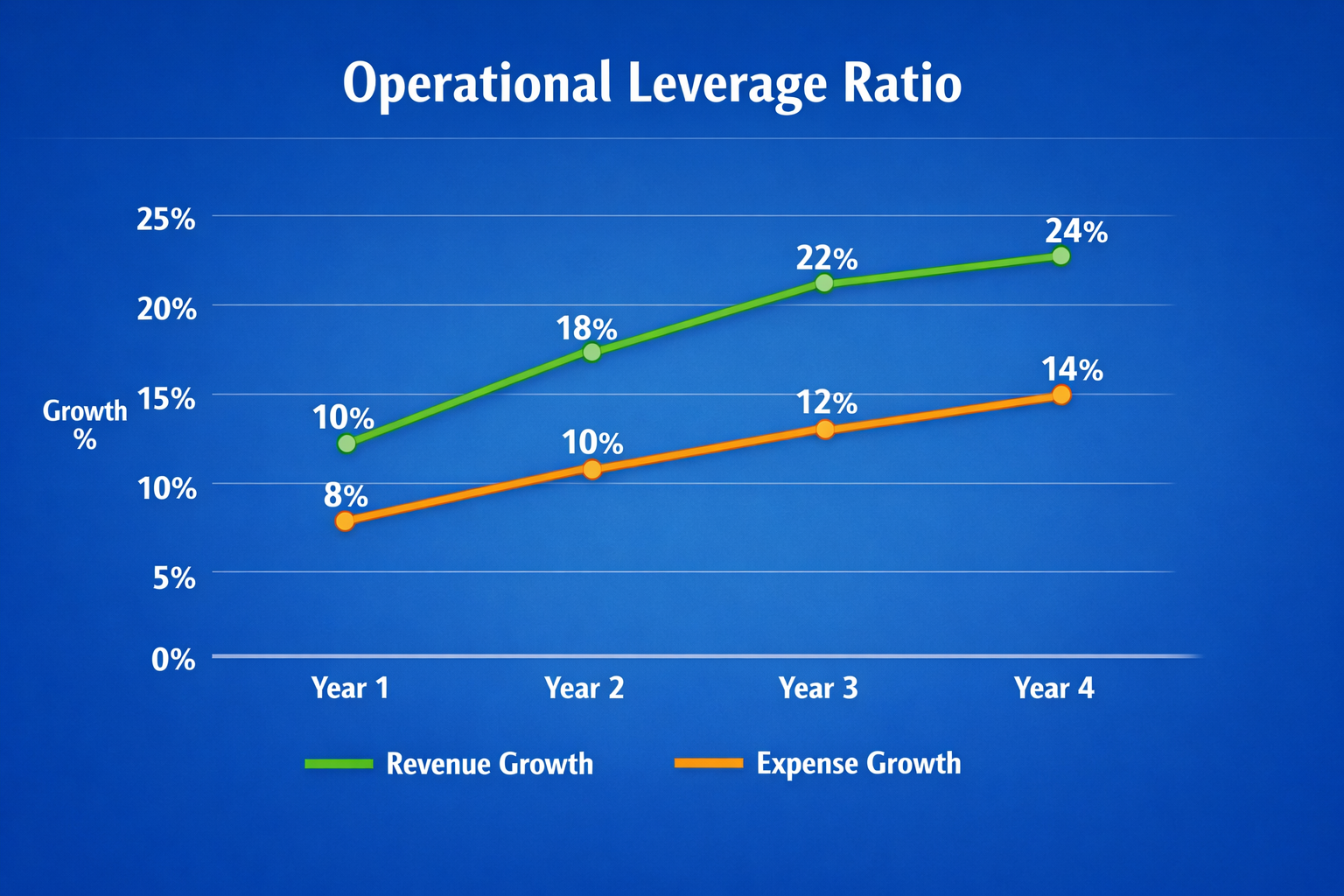
OLR is a key financial KPIs for small business USA that tracks if your revenue is growing at a faster rate than your day-to-day operating overhead.
OLR = Revenue Growth Rate (%) / Operating Expense Growth Rate (%)
How to Interpret It:
Why It Matters: A high OLR indicates that the business can scale efficiently because profits are growing faster than revenue.
Target Benchmark:
- 0 or higher: Excellent leverage. Revenue is expanding twice as fast as overhead costs.
- 0 to 2.0: Decent, but you are leaving significant efficiency on the table.
- Below 1.0: Highly dangerous. Your business is becoming less profitable as it grows.
How to Improve It: Stop hiring for every operational bottleneck. Invest heavily in software automation, build standardized internal operating procedures, and outsource accounting and bookkeeping (back-office tasks) to professional service providers.
KPI #6: Net Revenue Retention (NRR)
Net Revenue Retention measures a company’s ability to retain and grow revenue from its existing customers over a specific period. It takes into account revenue gained through upsells, cross-sells, and expansions, while also accounting for lost revenue due to customer churn and downgrades.
NRR=((Starting ARR +Expansion Revenue -Churned Revenue -Downgrade Revenue )/Starting ARR )×100
Why It Matters: A strong NRR indicates that customers are finding increasing value in your products or services. It is particularly important for SaaS companies, subscription businesses, consulting firms, and service providers because it shows that growth is being driven by customer retention and expansion rather than constant acquisition of new customers.
Target Benchmark:
- NRR above 100% means existing customers are spending more over time, offsetting any losses from churn.
- NRR at 100% means customer revenue is stable.
- NRR below 100% means revenue from existing customers is declining.
How to Improve It: Create a formal customer onboarding process to drive product adoption, launch structured account reviews, and build clear expansion or add-on product paths.

KPI #7: Gross Profit Margin Trajectory (GPMT)
GPMT is a financial KPIs for small business in USA that measures the direction and rate of change in a company’s gross profit margin over time. Rather than looking at a single-period margin, it evaluates whether gross profitability is improving, declining, or remaining stable across multiple reporting periods.
Revenue Per Employee=Total Annual Corporate Revenue /Total Number of Full-Time Employees
Why It Matters: A company’s gross profit margin is often one of the earliest indicators of financial health. Monitoring its trajectory helps businesses identify:
- Rising input or production costs
- Pricing pressure from competitors
- Changes in product or service mix
- Improvements in operational efficiency
- Long-term profitability trends
A positive trajectory suggests the business is becoming more profitable at the gross margin level, while a negative trajectory may signal margin erosion that requires management attention.
Target Benchmark: Your gross margin percentage should improve by 2% to 5% annually as you scale, driven by volume purchasing power and delivery efficiencies.
How to Improve It: Improve it by either increasing revenue, reducing direct costs, or doing both.
KPI #8: Revenue Per Employee (Labor Productivity Ratio)
This metric tracks the total amount of revenue your business generates for every full-time team member on your payroll. It acts as a true test for your hiring strategy, showing whether adding headcount is actually making your company more powerful or just making your office more crowded.
EBITDA Margin = (EBITDA ÷ Revenue) × 100
Why It Matters: This monthly financial metrics tracking provides insight into operational efficiency and workforce productivity. A higher ratio generally indicates that employees, processes, and technology are working together effectively to generate revenue. A lower ratio may suggest inefficiencies, overstaffing, underutilization of resources, or opportunities for process improvement.
Target Benchmark: There is no universal benchmark as RPE varies significantly by industry, business model, and company maturity. Yet, for many professional services firms, RPE between $150,000 and $300,000 is generally considered healthy.
How to Improve Revenue Per Employee:
- Automate repetitive and manual tasks.
- Invest in employee training and skill development.
- Improve operational workflows and productivity.
- Adopt technology that increases output without increasing headcount.
- Focus on higher-value products, services, and customers.
- Reduce administrative bottlenecks that limit employee effectiveness.
KPI #9: EBITDA Margin
EBITDA Margin measures how much operating profit a company generates from every dollar of revenue before interest, taxes, depreciation, and amortization.
EBITDA Margin = (EBITDA ÷ Revenue) × 100
Why It Matters: EBITDA Margin shows whether growth is actually creating value or simply increasing complexity and costs.
Target Benchmark:
- 20%+ = Excellent
- 10%–20% = Healthy
- Below 10% = Requires attention
How to Improve It: Improve pricing, eliminate low-margin services, automate processes, and reduce overhead.
KPI #10: Free Cash Flow Conversion (FCFC)
FCFC measures how efficiently accounting profits are getting converted into actual cash for growth, debt reduction, or owner distributions.
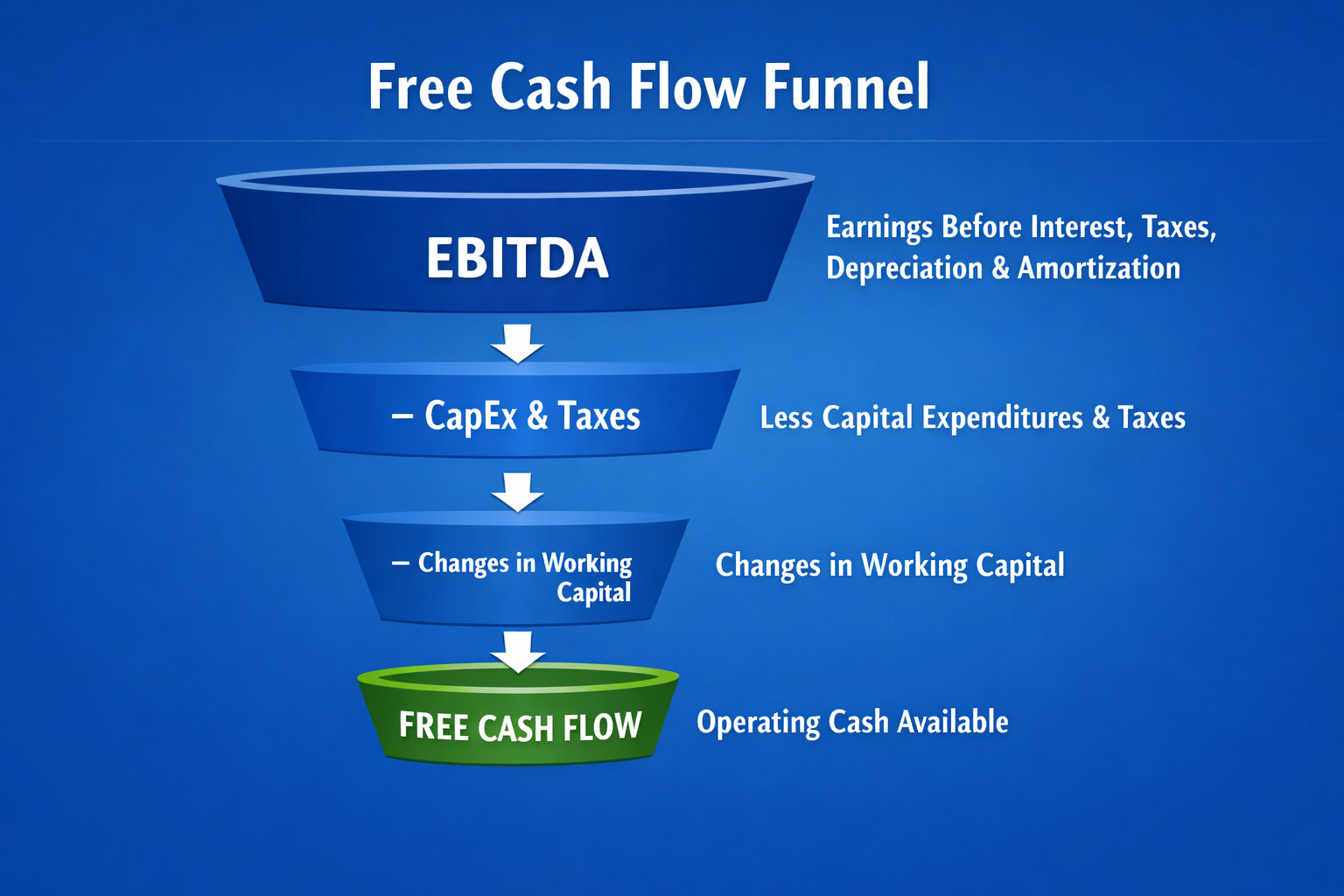
FCFC = Free Cash Flow ÷ EBITDA × 100
Why It Matters: Many companies appear profitable on paper but constantly struggle with cash shortages. FCFC reveals whether profits are truly turning into bankable cash.
Target Benchmark:
- Above 80% = Excellent
- 60%–80% = Healthy
- Below 60% = Cash leakage exists
How to Improve It: Improve collections, reduce inventory, tighten working capital controls, and manage capital expenditures.
The Growth-Focused Business KPI Dashboard
To see how these 10 performance indicators connect across your entire growth-stage organization, use this monthly benchmark summary matrix:
| Metric Type | Simple Metric | Target Scale Benchmark | Ideal Frequency |
|---|---|---|---|
| Cash Velocity | The Cash Gap (CCC) | Under 30 Days | Monthly |
| Productivity | Team Production Score (RPE) | Upward Trend (e.g., $150k+) | Monthly |
| Risk Warning | Customer Reliance Score (RCI) | Under 20% | Quarterly |
| Asset Safety | Working Capital Ratio (Current Ratio) | 1.5 – 2.0 | Monthly |
| Sales Efficiency | The New Customer Score (UEER) | 3:1 Ratio or Higher | Monthly |
| Core Profits | Operational Core Profit (EBITDA %) | 10% – 20%+ (Industry Dependent) | Monthly |
| Overhead Control | Growth Efficiency Ratio (OLR) | 2.0 or Higher | Monthly |
| Cost Direction | Delivery Margin Trend (GPMT) | Positive Vector (+2%–5% YoY) | Quarterly |
| Client Retention | Existing Client Growth (NRR) | Over 100% | Monthly |
| True Wealth | Profit-to-Cash Conversion (FCFC) | Above 80% | Monthly |
Moving From Hustle to Predictable Scale
Crossing $1 million in revenue happens through sheer founder grit and hustle. But scaling from $1 million requires a completely different playbook. You can no longer run the company by just looking at money in your bank.
It can happen only through rigorous monthly financial metrics tracking. By focusing on these 10 straightforward indicators, you can see exactly how your business is scaling and how you can prepare your corporate infrastructure for true, predictable growth.
Need help turning your financial data into strategic drivers? Partner with us.
At KnowVisory Global, we help growing businesses move beyond basic bookkeeping and provide them the financial insights, reports, and business KPI dashboards they need to improve financial performance and scale with confidence.
Whether you’re looking to strengthen cash flow, improve profitability, or build a more predictable growth strategy, our team can help you transform financial data into actionable business intelligence.
Schedule a discovery call to know how our outsourced accounting and financial reporting solutions can support your next stage of growth.