Every business, no matter its size, runs on numbers.
Yet, most businesses, especially during their foundation years, manage their finances without a clear system. Owners record transactions inconsistently, generate reports only when needed, and make financial decisions on incomplete data.
But without a structured approach, even profitable businesses struggle with cash flow, compliance, and reporting. And by the time these issues are discovered, fixing them becomes time-consuming and expensive.
That’s why, it is important to follow a proper accounting cycle.
The accounting cycle is not just an accounting process, it’s a disciplined framework that ensures every financial transaction is recorded, verified, and reflected accurately in your books.
When followed properly, it gives you complete clarity on where your business stands and helps you make smarter, faster decisions.
Let’s see what it is, how it works, and how it can help you strengthen the financial foundation of your business.
What is an Accounting Cycle?
An accounting cycle is a step-by-step process to record and manage a company’s financial transactions over a specific period of time.
It starts when a transaction occurs (a sale, expense, or payment) and ends when financial statements are prepared and accounts are closed for that particular period.
Once completed, the cycle begins again for the next period.
At its core, the accounting cycle ensures one thing: your financial data is accurate, complete, and ready for decision-making. It turns your numbers into a tool for growth—not just record-keeping.
When followed consistently, it helps you gain:
- Clear visibility into income and expenses
- Reliable financial reports
- Better control over cash flow
- Confidence during audits or investor discussions
Why is Accounting Cycle Important?
Many business owners treat accounting services as a back-office function – important for taxes but not for growth.
This mindset can hold your business back because poor financial visibility doesn’t show up immediately, it builds quietly over time.
You may think your margins are healthy, but hidden costs might eat into profits. You may believe you have enough runway, but unrecorded expenses shorten it.
The accounting cycle eliminates this uncertainty.
With real-time visibility into financial performance, it helps you gain better control over costs and replaces guesswork with precision.
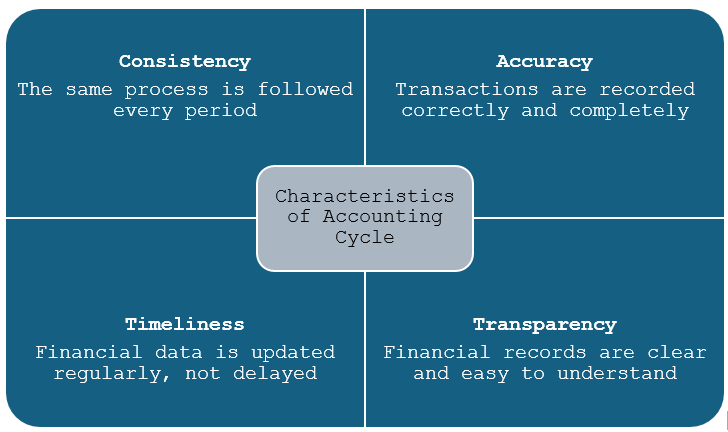
Key Characteristics of an Effective Accounting Cycle
A strong accounting cycle is defined by four important elements that ensure your financial foundation remains strong as your business expands.
The 8 Essential Steps of the Accounting Cycle
The accounting cycle follows a structured eight-step process. Each step plays a critical role in ensuring financial accuracy.
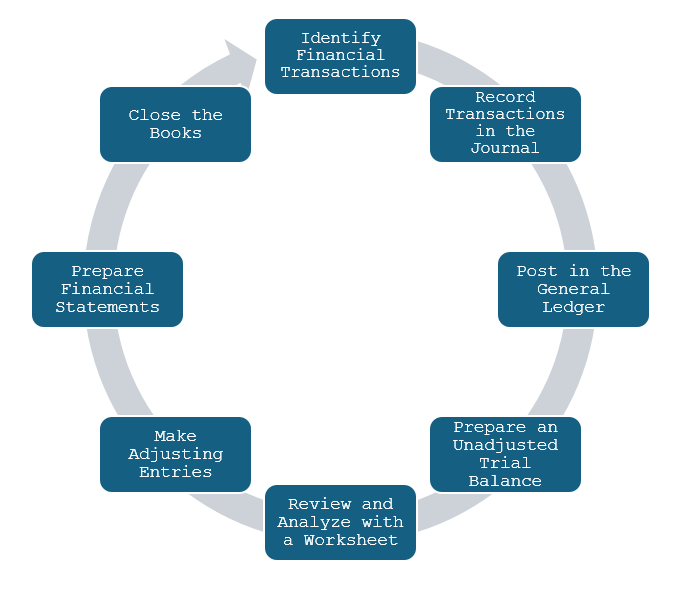
- Identify Financial Transactions
The process begins by identifying all financial activities that impact your business. These include sales and revenue, business expenses, vendor payments, customer receipts, and loans and investments.
- Record Transactions in the Journal
Each transaction is documented as a journal entry. It includes all important details like date, amount, and accounts involved.
It follows the Double-entry bookkeeping principle and ensures that every recorded transaction is balanced.
- Post to the General Ledger
Journal entries are then transferred to the general ledger, where transactions are categorized under specific accounts for better tracking.
This makes it easier to track financial activity by account.
- Prepare an Unadjusted Trial Balance
All ledger balances are compiled into a trial balance to ensure total debits must equal total credits. This step acts as a checkpoint before moving to adjustments and reporting.
- Review and Analyze Financial Data
A worksheet is used to identify any discrepancies (missing entries, incorrect classification, or timing differences) or adjustments needed before finalizing the accounts. It ensures your data reflects the true financial position before final reporting.
- Record Adjusting Entries
Adjustments are made to account for transactions that are not yet fully captured. These include accrued expenses, earned but unreceived revenue, prepaid expenses, and depreciation.
- Prepare Financial Statements
After adjustments, financial statements are created. These include:
- Income Statement: That shows profit or loss
- Balance Sheet: To display assets, liabilities, and equity
- Cash Flow Statement: That tracks cash movement
These reports give a complete view of your business’s financial health.
- Closing the Books
The final step is closing temporary accounts such as revenues and expenses. Balances are transferred to retained earnings. This resets the system for the next accounting period.
When Should the Accounting Cycle Be Completed?
The accounting cycle runs within a defined timeframe known as an accounting period.
This can be monthly, quarterly, or annually.
Yet, most growing businesses prefer monthly cycles to maintain better control and visibility. It helps your financial data stay current and useful.
Common Challenges Businesses Face
Even after having a clearly defined process, businesses may not achieve desired results. This could happen if there is:
- Delays in recording transaction
- Poor expense categorization
- Missing documentation
- Manual errors
- Lack of regular reconciliation
Ways to Ensure Strong Accounting Process
To maintain clean and reliable books:
- Make sure to record your transactions consistently. Avoid delays or bulk entries
- Categorize expenses properly to improve reporting accuracy and give better visibility into where your money is going.
- Reconcile your books with bank statements to catch errors early and maintain accuracy.
- Maintain a regular closing schedule (ideally, every month) to stay on top of your numbers.
- Keep invoices, receipts, and supporting records organized for easy tracking and compliance.
- Automate your accounting process to reduce manual errors and simplify your overall accounting process.
It’s Time to Gain Complete Clarity Over Your Numbers
The accounting cycle is more than just a routine. It is the backbone of your business that brings structure, accuracy, and clarity to your financial data.
When implemented correctly, it ensures every financial transaction is recorded, reviewed, and reported accurately so you get the insights you need to make informed business decisions.
So, take control of your finances through accurate accounting cycle and build a system you can truly rely on. Contact us today to get started.