A Chart of Accounts (COA) solves this by giving structure to your finances. It tells you exactly where each transaction should go, making sure all your business transactions are recorded correctly. It acts as a guide that helps you organize your financial data accurately, so every number has a clear place.
Let’s see what a COA is, why it plays such a critical role in your accounting system, and how to set up a chart of accounts for your business.
What is a chart of accounts (CoA)?
A Chart of Accounts (COA) is a structured list of all financial accounts in a company’s general ledger, organized using a numbering system. It categorizes transactions into key groups such as assets, liabilities, equity, revenue, and expenses. Serving as the foundation of financial reporting, the COA ensures consistency in bookkeeping and enables businesses to accurately monitor their financial performance and position.
Think of it as a well-organized filing system for your finances. Every transaction—whether it’s a sale, expense, or payment—gets recorded under a specific account in the COA.
Instead of having scattered or unstructured data, your COA makes sure everything is categorized logically and organized consistently.
A good CoA helps you:
- Track your finances
- Generate accurate financial reports (P&L statements, Balance Sheet)
- Understand where your money is coming from and going
- Make better business decisions with clear insights
- Prepare for a fundraise
- Meet regulatory requirements.
It must respect the guidelines set out by the Financial Accounting Standards Board (FASB) and generally accepted accounting principles (GAAP)
The 5 Main Categories in a Chart of Accounts
A standard COA typically divided into two main categories: Balance Sheet Accounts and Income Statement Accounts.
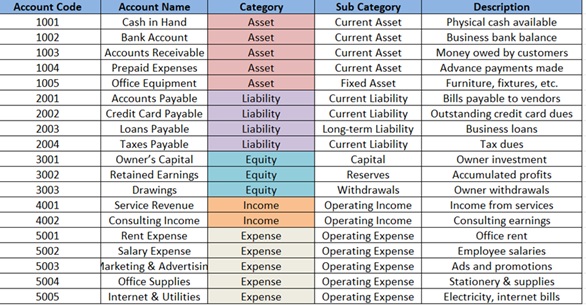
Each of these categories is further divided into specific account types with a specific reference number, which helps in easy identification of accounts. The leading digit of the reference number indicates the account type and subsequent digits denotes specific details.
1. Balance Sheet Accounts
Assets (Reference number: 1XXX): It represents everything your business owns (cash, bank balances, inventory, accounts receivable, equipment and machinery).
Liabilities (Reference number: 2XXX): Liabilities are what your business owes to others (loans, accounts payable, credit cards, taxes).
Equity (Reference number: 3XXX): It represents the owner’s stake in the business, like owner’s capital, retained earnings, and drawings. It reflects how much of the business belongs to the owner after liabilities are deducted.
2. Income Statement Accounts
Income/Revenue (Reference number: 4XXX): Money that your business earns from products and services. Examples include sales revenue, service income, and interest income.
Expenses (Reference number: 5XXX): Expenses represent the costs incurred to run your business (rent, utilities, salaries, marketing expenses, office supplies).
How a Chart of Accounts Works
The COA adheres to the double-entry bookkeeping principles, where every transaction records a debit in one account and a corresponding credit in another.
Here, one account increases while another is adjusted accordingly. This ensures that your books always stay balanced.
For example, when you receive payment from a client, your Asset Account (bank account) increases, and the same transaction is also recorded in the appropriate Asset account (in this case income).
This way your chart of accounts always stays balanced, and the sum of the two entries always remain zero.
Sample Chart of Account
Sample Transaction Sheet

Why a Chart of Accounts is Important
Many businesses underestimate the importance of a well-structured Chart of Accounts. However, it directly affects how efficiently you manage your finances.
- It Keeps Your Finances Organized
A COA makes sure every transaction you make has a proper place in records. It reduces confusion and keeps your financial data structured and easy to track.
- COA Improves Financial Reporting
Accurate categorization of transactions leads to reliable financial reports. You can clearly see your income, expenses, and profitability without making any mistakes.
- Supports Better Decision-Making
When your financial data is organized, it becomes easier to analyze trends, control costs, and plan for growth.
- COA Simplifies Tax Compliance
A structured COA makes it easier to track deductible expenses and prepare accurate tax filings.
- It Saves Time and Reduces Errors
A well-designed COA prevents errors from happening in the first place. It saves tons of time that goes into fixing mistakes later.
How to Create an Effective Chart of Accounts
A good COA should not just be detailed but also practical and easy to use. Here’s how to create a well-structured COA:
- Categorize the transactions accurately: Make sure every transaction is recorded under the correct account. Clearly define categories like assets, liabilities, income, and expenses so there’s no confusion while recording entries.
- Keep it simple and relevant: Avoid creating too many unnecessary accounts. Start with essential categories and expand only when needed to keep your system easy to manage.
- Use a logical numbering system: Assign account codes in a structured way (e.g., 1000 for assets, 2000 for liabilities). This makes your COA more organized and easier to navigate.
- Customize it to your business: Your COA should reflect how your business operates. A service-based business will have different accounts compared to an eCommerce or manufacturing business.
- Review and update regularly: Regularly review your COA and update it to reflect new income streams or expense categories.
Common Mistakes Businesses Make
Even though a COA is simple in concept, many businesses don’t set it up correctly. They usually:
- Overcomplicate the structure by adding too many unnecessary accounts which makes COA difficult to manage.
- Use generic categories like “Miscellaneous Expenses”, which makes financial analysis harder.
- Do not update the COA regularly as the business evolve.
- Mix personal and business expenses, which creates confusion and impacts the accuracy of financial reports.
Get your COA Right for Better Insights, Smoother Reporting, and Fewer Financial Errors
A Chart of Accounts may seem like a basic accounting tool, but it has a direct impact on how you present and understand your business finances.
A well-structured COA brings structure and clarity to your numbers. It improves reporting accuracy and provides you a clear and complete picture of your financial health.
At KnowVisory Global, we don’t just set up your Chart of Accounts—we build a structured financial system tailored to your business. Our experts clean up, catch up and set up your books and accounts, so your numbers are always accurate, compliant, and easy to understand.
Whether you’re starting fresh or fixing a messy setup, we help you gain complete control over your finances. Contact us today to streamline your accounts and make smarter business decisions with confidence.