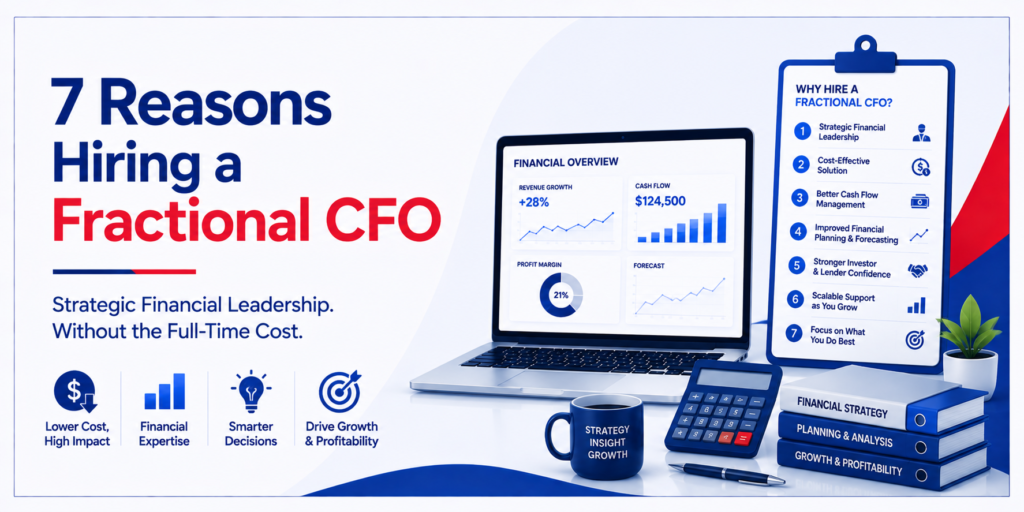
7 Reasons Hiring a Fractional CFO
As a business grows, financial decisions become more complicated. Managing cash flow, setting budgets, forecasting revenue, evaluating investments, preparing for funding, and understanding profitability can quickly go beyond the scope of routine bookkeeping and accounting. At the same time, hiring a full-time Chief Financial Officer may not make financial sense for every company. This is where fractional CFO services can provide a practical middle ground: senior-level financial expertise delivered on a part-time, contract, or project basis. Instead of paying for a full-time executive, you get financial leadership sized to what your business actually needs right now — which is exactly why the model has become so popular with small and midsize businesses looking to grow without overextending their resources. What Does a Fractional CFO Do? A fractional CFO is an experienced finance professional who works with a business without becoming a full-time employee. Depending on the engagement, their responsibilities can include: Cash flow planning and management Financial forecasting and modeling Financial reporting and performance analysis Profitability analysis Strategic financial planning Capital planning and fundraising support Financial risk assessment Business expansion and investment analysis The real difference from a traditional CFO isn’t the skill set – it’s the commitment. You might engage a fractional CFO for a few hours a week, on a monthly retainer, for a single project, or just through a critical growth stage. That flexibility makes the model especially useful when you need financial leadership but aren’t ready for (or don’t need) a full-time hire. 7 Reasons Hiring a Fractional CFO is a Smart Move for a Growing Business CFO-Level Expertise Without a Full-Time Executive Cost A full-time CFO represents a significant investment. In addition to salary, businesses may need to account for bonuses, benefits, payroll costs, and other employment-related expenses. For a growing company, taking on that fixed cost before the need truly exists can put unnecessary pressure on the budget. Part-time CFO services provide a competitive alternative. The business pays for an agreed level of support rather than maintaining a full-time executive seat. This enables companies to: Access senior financial expertise without a full-time salary Adjust the amount of support as business needs change Avoid additional employee overhead Direct more capital toward operations, hiring, technology, or expansion The goal isn’t simply to spend less on finance. It is to obtain the right level of financial expertise at the right stage of the business. |Also Read: Fractional CFO vs Outsourced FP&A: Which Does Your US Business Actually Need? | Financial Strategy into Everyday Business Decisions Bookkeeping tells you what has already happened. A CFO helps management understand what those numbers mean and what should happen next. A fractional CFO turns raw numbers into answers to the questions that actually keep founders up at night: Can we afford to hire additional employees? How much cash should we keep in reserve? Which products or services generate the strongest margins? Can we expand without creating a cash shortage? What happens to profitability if costs increase? How much funding might we need over the next 12 months? This kind of analysis gives business owners a stronger financial basis for making decisions instead of relying primarily on intuition. Sharper Cash Flow Visibility — and Better Margins A business can be profitable on paper and still run into cash flow trouble. A fractional CFO looks at the full cash cycle to see where money is coming from, where it’s going, and where delays or inefficiencies are quietly draining liquidity — often through: Reviewing receivables and collection patterns Analyzing payment schedules and vendor terms Monitoring operating expenses Reviewing gross and net margins Flagging low-profitability products, services, or customers Building forward-looking cash flow forecasts This isn’t about cutting costs across the board — it’s about understanding how specific decisions ripple through cash, margins, and long-term profitability, so problems get caught early instead of becoming emergencies. A Financial Roadmap for Growth Growth raises questions that historical accounting data alone can’t answer. How much working capital will expansion actually require? Are current resources enough? What happens to margins along the way? A fractional CFO builds financial models that test these scenarios before you commit, comparing options like: Opening a new location Launching a new product Expanding the sales team Entering a new market Increasing production capacity Taking on additional debt Instead of asking “does this opportunity look good?”, leadership can ask “what will this actually do to our numbers?” – reducing the risk of growing faster than the business can financially support. A Business for Fundraising, Lending, or Major Transactions Lenders, investors, and acquirers all expect clean, credible financial information. A fractional CFO helps get you there by: Reviewing financial statements Building forecasts and financial models Preparing management reporting Analyzing historical performance Developing funding requirements Supporting due diligence Packaging financials for lenders or investors Strong documentation makes it easier for outsiders to understand your performance and potential — and it puts your team in a stronger position at the negotiating table. Better Financial Systems and Reporting When financial data is scattered across spreadsheets, accounting software, and disconnected operational tools, good decisions get harder to make. A fractional CFO evaluates how information flows through the business and tightens up: Management reporting Budgeting and forecasting processes Financial dashboards and KPI tracking Cash flow reporting Accounting system integrations Automated reporting and planning models The payoff isn’t just saved admin time — it’s a finance function that surfaces trends and problems early, instead of just recording what already happened. An Independent Financial Perspective Business owners and internal teams can become deeply involved in day-to-day operations. That can make it difficult to step back and objectively evaluate financial decisions. A fractional CFO brings an external perspective to the leadership team. Because they are not tied to a particular department or operational decision, they can challenge assumptions and ask difficult financial questions, like: Is this investment likely to generate an acceptable return? Are we carrying expenses that no longer support the business? Are our growth expectations realistic? Are we allocating capital to