







A practical partner for ERP change
An ERP transition is more than moving records between systems. It is an opportunity to improve the finance and operational processes that run your business – while protecting continuity, controls, and the quality of your reporting.
KnowVisory Global helps clients plan and manage the transition from their current environment to a selected ERP. We bring together finance, process, data, and change-management disciplines so your team can make informed decisions and move through implementation with less disruption.
With us, you get:
- A realistic, milestone-based implementation roadmap instead of an open-
- ended timeline
- Clean, validated data moved into your new system — not a copy of old errors
- Configuration built around how your business actually operates, not a rigid
- template
- A trained, confident workforce ready to use the system from day one
Our delivery boundary We provide ERP transition consulting, project support, data migration, process and control advisory, testing, training, and go-live support. Where custom development, integrations, or platform-specific technical work is required, we help define requirements, coordinate with your ERP vendor or technical partner, and validate the outcome against your business needs. |
Who We Help
Our services are suited to organizations that are replacing an accounting system, moving from legacy accounting system or spreadsheets to an ERP, consolidating systems after growth or acquisition, or seeking stronger financial control and reporting visibility.

Growing businesses
Moving from QuickBooks, Xero, Sage, spreadsheets, or legacy accounting tools to a scalable ERP.

Finance and operations teams
Migrating from one ERP platform to another, including multi-entity or multi-currency environments.

Leadership teams
That need an independent partner to organize the transition, protect data quality, and strengthen adoption.

Organizations
That need additional capacity for a defined phase of an ERP program, from discovery through post-go-live stabilization.
Our ERP Transition Services
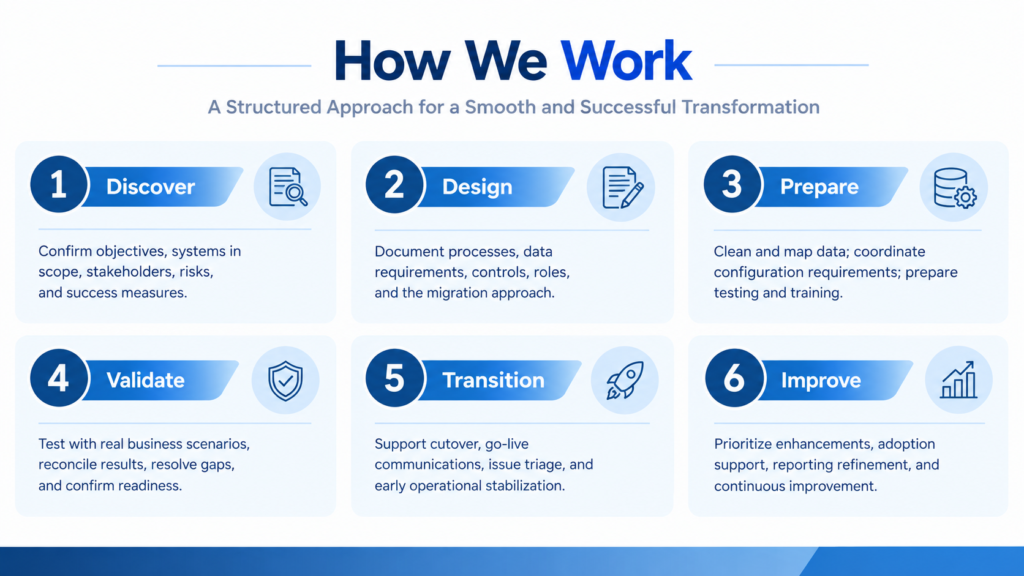
From the first requirements workshop to long-term optimization, we cover every stage of the ERP lifecycle so nothing falls through the cracks.

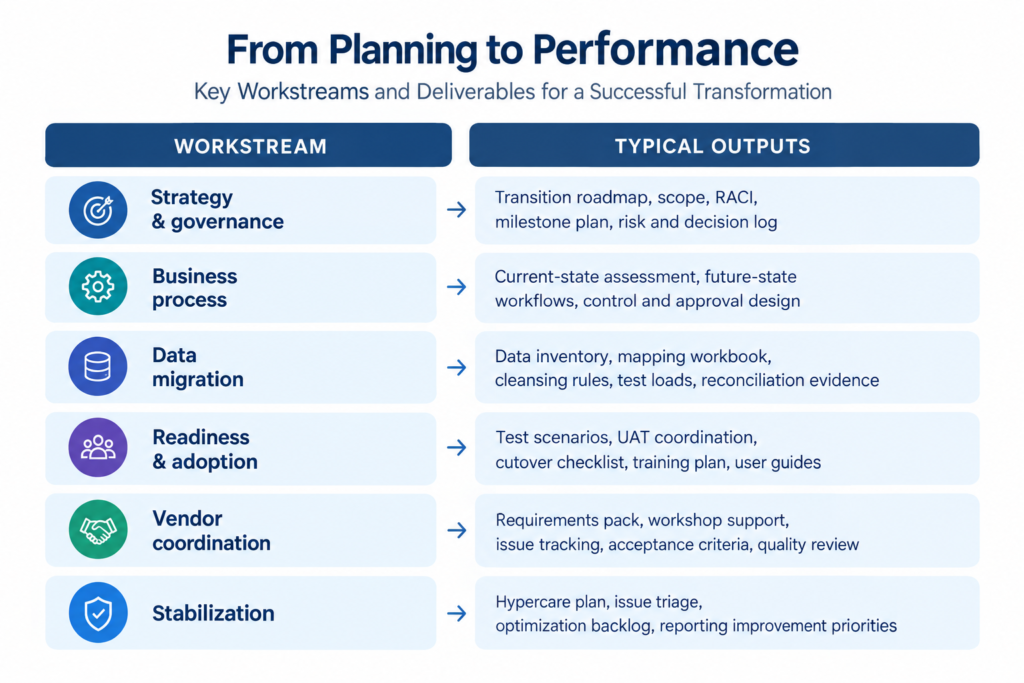
We assess your current systems, data, processes, risks, stakeholders, and desired outcomes. The result is a practical transition roadmap with priorities, milestones, owners, dependencies, and decision points.

If you have not selected a platform, we translate business needs into a structured requirements set and support vendor evaluation. If you have selected a platform, we help prepare clear requirements and governance for the implementation partner.

We document current workflows and design fit-for-purpose future-state processes across finance, purchasing, order-to-cash, inventory, reporting, approvals, and operational handoffs. We focus on practical simplification and appropriate financial controls.

We manage the business-side data migration process from your existing ERP, accounting system, QuickBooks, spreadsheets, and supporting records into your new ERP.

We provide structured project support across scope, requirements, workshops, decisions, test plans, issue management, and readiness reporting. We can work alongside your selected ERP vendor or technical implementation partner to keep business needs visible and risks managed.

We organize business-scenario testing, support user acceptance testing, prepare role-based training and user materials, and help manage cutover and hypercare. The goal is a confident team and a controlled transition into day-to-day operations.

After launch, we help prioritize fixes, refine workflows and reports, resolve adoption gaps, and establish a continuous-improvement backlog so the new ERP continues to support growth.
What an Engagement Can Include


Why KnowVisory Global

ERP decisions are grounded in accounting accuracy, reporting quality, internal controls, and operational reality.

We work from your processes and desired outcomes, while coordinating effectively with ERP vendors and technical partners.

Data cleansing, mapping, test loads, and reconciliation are planned as core workstreams - not last-minute tasks.

We treat user readiness, training, communication, and hypercare as essential to adoption.

Use us for an end-to-end transition or a focused workstream such as data migration, readiness, UAT, or project assurance.
Ready to plan your ERP transition?
FAQs
Can you help us move from QuickBooks to NetSuite?
Yes. We can support the business side of a QuickBooks-to-NetSuite transition end to end: readiness assessment, requirements, data extraction and cleansing, mapping, test loads, reconciliation, UAT, training, cutover, and post-go-live support. Platform configuration and any custom technical development are completed by your NetSuite provider or qualified technical partner; we help make sure the work aligns with your operating and reporting needs.
Can you work with our ERP vendor or implementation partner?
Yes. We can act as your business-side transition partner, providing requirements clarity, project coordination, data and process support, testing oversight, readiness reporting, and independent quality assurance alongside your vendor or technical implementation partner.
What data can you help migrate?
The scope depends on the target ERP and business needs. Typical data sets include the chart of accounts, customers, vendors, open receivables and payables, account balances, inventory, fixed assets, purchase and sales records, and selected historical reporting data. We agree the required history and reconciliation approach early in the project.
How long does an ERP transition take?
Timing depends on the number of entities, data quality, process complexity, target platform, integrations, and availability of client stakeholders. We establish a phased, milestone-based roadmap during discovery rather than relying on a generic timeline.
Can you review an ERP transition already underway?
Yes. We can provide independent project assurance, including a review of scope, governance, data migration readiness, testing, business-process alignment, user readiness, and key risks before go-live.