But outsourcing does not mean handing over everything and stepping away. The businesses that get the most value from outsourced accounting services are usually the ones that make a clear distinction between work that can be delegated, work that requires review, and decisions that should remain with business leadership. That makes the real question less about whether to outsource accounting and more about how to structure the relationship so the business gains capacity without losing control.
What Outsourced Accounting Actually Includes
Outsourced accounting can cover far more than basic bookkeeping. Depending on the business’s size, industry, accounting systems, and internal team, an outsourced partner may support:
- Bookkeeping and transaction recording
- Bank and credit card reconciliations
- Accounts payable
- Accounts receivable
- Invoicing and collections support
- General ledger management
- Month-end close
- Financial statement preparation
- Cash flow management
- Cleanup and catch-up bookkeeping
- Payroll accounting support
- Audit and tax preparation support
- Controller-level accounting
- Financial analysis and reporting support
Modern finance and accounting outsourcing is increasingly structured across these different levels, from transactional processing through month-end close and reporting to more specialized finance support. The important point is that outsourcing does not have to be all-or-nothing. A business can start with one accounting process and expand the scope as the relationship, systems, and controls mature.
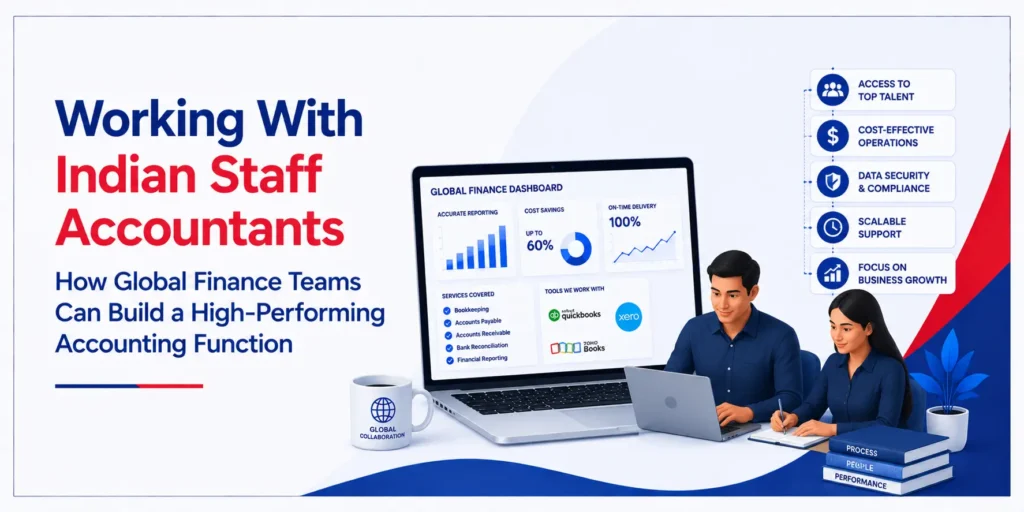
|Also Read: Working with Indian Staff Accountants: How Global Finance Teams Can Build a High-Performing Accounting Function|
What Should You Outsource?
The right starting point depends on where your internal team is spending time and where accounting bottlenecks are affecting the business. Five areas tend to be well suited to outsourced support.
- Bookkeeping and Transaction Processing
Routine transaction processing can consume significant internal time without necessarily requiring a full-time accounting employee. An outsourced team can manage:
- Transaction categorization
- General ledger updates
- Journal entries
- Bank and credit card reconciliations
- Expense recording
- Supporting documentation
- Account reconciliations
The objective isn’t simply to have someone keep the books. It is to maintain accounting records consistently, so that financial information is ready when management needs it.
- Accounts Payable
AP is one of the most process-driven areas of accounting, which makes it a practical candidate for outsourcing. A structured AP process can include vendor bill entry, invoice verification, PO or supporting-document matching, approval workflow coordination, vendor statement reconciliation, payment scheduling support, AP aging monitoring, and exception reporting.
The business can retain approval and payment authority while the accounting partner manages the underlying workflow. That separation matters:
The outsourced team manages the process. The business retains control over the decision.
- Accounts Receivable
Slow or inconsistent AR processes create problems that extend well beyond bookkeeping. An outsourced accounting team can support:
- Customer invoicing
- Payment application
- AR reconciliations
- Aging reports
- Outstanding balance tracking
- Collections follow-up
- Customer account updates
- AR reporting
Done well, this gives management better visibility into what has been billed, what has been collected, and where outstanding receivables require attention.
- Bank and Credit Card Reconciliations
Reconciliations are repetitive, but they are also fundamental to accurate financial reporting. A structured reconciliation process helps identify missing transactions, duplicate entries, unreconciled items, incorrect classifications, timing differences, unusual transactions, and outstanding checks or deposits.
Regular reconciliation also makes month-end close more predictable, because unresolved issues aren’t accumulating until the final days of the month.
- Month-End Close and Financial Reporting
This is where outsourced accounting moves beyond basic bookkeeping. A mature close process typically requires:
- Completing transaction processing
- Closing AP and AR activities
- Reconciling balance sheet accounts
- Posting required journal entries
- Reviewing unusual balances
- Finalizing the general ledger
- Preparing financial statements
- Reviewing results and exceptions
A structured close calendar, defined ownership, and preparer-reviewer controls all help reduce delays and improve consistency. The output should be more than a completed set of books. It should be financial information that management can actually use.
Which Accounting Functions Should Stay In-House?
Outsourcing the accounting work does not mean outsourcing ownership of it. Business leadership should generally retain responsibility for:
- Financial strategy
- Approval authority
- Banking relationships
- Major expenditures
- Business planning
- Capital allocation
- Risk decisions
- Final management decisions
- Ownership of financial policies and controls
Your accounting partner can prepare the information and provide insight. Your leadership team should remain in control of what the business does with it. This distinction matters most when outsourcing AP, payroll-related processes, banking activities, or other areas involving financial authority.
The Biggest Mistake: Treating Outsourcing as a Cost-Cutting Exercise
Cost is certainly a factor. But choosing a provider purely because the hourly rate is lower tends to create problems later. A low-cost provider that delivers inconsistent reconciliations, delayed reporting, limited communication, poor documentation, inadequate review, or frequent staff changes can end up creating more work for your internal team than it removes.
A better question to ask is: what accounting capacity, expertise, and control am I getting for the investment? That reframes the evaluation from a labor-cost comparison into an operating-model decision.
What a Strong Outsourced Accounting Model Looks Like
A successful outsourced accounting relationship needs more structure than giving an external team access to QuickBooks. Look for five things.
- Clearly Defined Responsibilities
Everyone should know what the outsourced team as well as the internal team handles, who approves transactions, who reviews reconciliations, who owns deadlines, and who answers questions. Ambiguity creates delays.
- A Defined Month-End Close Process
A reliable close should have a documented checklist, named task owners, deadlines, required supporting documentation, reconciliation procedures, review checkpoints, and exception tracking. The close should become a repeatable process rather than a monthly scramble.
- A Review Layer
One of the most important questions to ask any accounting provider is: who reviews the work?
A preparer-reviewer structure adds a quality-control layer to the entire process. And this is what often separates an outsourced team from a freelancer. Rather than simply handing back books and accounts, the provider’s internal reviewers check reconciliations for unresolved items, journal entries for support and classification, balance sheet accounts for unusual movement, and financial statements for consistency before anything reaches you.
- Consistent Communication
Outsourcing should not mean waiting until month-end to discover that something is missing. Make sure to set a good operating rhythm right from Day one. It includes weekly updates, open-item tracking, exception reporting, monthly close meetings, clear escalation procedures, and defined response times. This becomes especially important when the outsourced team works in a different location or time zone.
- Scalability
Your accounting needs today may not be your accounting needs twelve months from now. A growing business might initially need only bookkeeping and reconciliations, then progress along a fairly predictable path:
Bookkeeping → AP/AR → Month-End Close → Financial Reporting → Controller Support
An outsourced partner should be able to expand alongside the business without forcing you to rebuild the accounting process each time.
How Much Accounting Should You Outsource?
There is no universal percentage. Instead, look for accounting activities that are:
- Highly repeatable. These are often the strongest candidates for outsourcing.
- Process-driven. Documented workflows make handoffs easier.
- Time-consuming. If your internal team spends hours every week on recurring accounting work, outsourcing creates capacity.
- Dependent on specialized expertise. Outsourcing provides access to accounting professionals without requiring every skill to be hired internally.
- Creating operational bottlenecks. If AP, AR, reconciliations, or month-end close consistently fall behind, additional accounting capacity may be more valuable than another generalist hire.
The aim isn’t to outsource as much as possible. It’s to build the right accounting operating model for your business.
When Should a Business Consider Outsourced Accounting?
Outsourcing may be worth exploring when:
- The founder is still heavily involved in bookkeeping
- The accounting team is overloaded
- Financial reports are consistently delayed
- Bank reconciliations are falling behind
- AP or AR requires constant follow-up
- Month-end close takes too long
- The company is growing faster than its accounting infrastructure
- Hiring a full accounting department doesn’t make financial sense
- The business needs controller-level expertise without a full-time controller
- Management wants better financial visibility
One signal matters more than most: the company has outgrown its existing accounting process but isn’t ready to build a much larger internal finance team. That gap is often where a well-structured outsourced model fits best.
How to Choose an Outsourced Accounting Partner
Before selecting a provider, ask more than “How much do you charge?”
Who will actually work on my account?
You should know whether the work is handled by a dedicated team, a rotating pool of staff, or a single individual.
Who reviews the work?
It is important to understand the quality-control and review structure before partnering with an outsourced service provider.
What exactly is included?
Clarify whether bookkeeping, reconciliations, AP, AR, close, and reporting are included or treated as separate services.
- What happens during month-end? Ask for the actual workflow and expected timeline.
- How do you handle exceptions? Accounting isn’t always clean and predictable. Find out how unusual transactions and missing information get escalated.
- How will we communicate? Define meetings, reporting, response times, and escalation points.
- Can the team scale? Your partner should be able to support changes in transaction volume, entities, locations, and reporting requirements.
- What happens if our needs change? A good outsourcing relationship should be flexible enough to expand, reduce, or change scope as the business evolves.
Outsourced Accounting Should Give You More Than Bookkeeping
The real value of outsourced accounting isn’t in moving accounting tasks outside the company. It’s in creating a more reliable financial operation.
When transactions are recorded consistently, reconciliations are completed on schedule, AP and AR are actively managed, and month-end reporting follows a defined process, leadership gets something considerably more valuable than a clean ledger: better visibility into the business. That visibility supports a clearer view of cash position, profitability, outstanding receivables, upcoming obligations, and changes in financial performance.
That is the point at which outsourced accounting stops being a back-office service and becomes a meaningful part of how the business operates.
How KnowVisory Global Supports Growing Businesses
At KnowVisory Global, we provide outsourced accounting support designed around the way your business actually operates. Our accounting teams can support:
- Bookkeeping
- Accounts Payable
- Accounts Receivable
- Bank & Credit Card Reconciliations
- Month-End Close
- Financial Reporting
- Mortgage Accounting
- Accounting Cleanup
- Controller and finance support
Our model combines accounting professionals with CPA-backed review and oversight, giving businesses access to experienced accounting resources without having to build every capability internally. Whether you need additional capacity for an existing finance team or a more comprehensive outsourced setup, the scope can be structured around your requirements.
You retain control of your financial decisions. We help you manage the accounting work behind them.
Ready to rethink your accounting model?
If your accounting team is spending too much time keeping up with recurring work, or your financial reporting isn’t keeping pace with your business, let’s discuss what could be outsourced and where additional accounting capacity would make the biggest difference.
Talk to KnowVisory Global about your outsourced accounting requirements.
Frequently Asked Questions
Is outsourced accounting the same as bookkeeping?
No. Bookkeeping is one component of outsourced accounting. A broader engagement can include AP, AR, reconciliations, month-end close, financial reporting, and controller-level support.
Will I lose control if I outsource my accounting?
Not necessarily. A properly structured model separates accounting execution from financial authority. The outsourced team prepares and manages accounting processes while your business retains approval rights, banking authority, and financial decision-making.
Can I outsource only part of my accounting?
Yes. Businesses can outsource specific processes such as AR, AP, reconciliations, or bookkeeping, and then expand the scope as their needs change.
Is outsourced accounting suitable for growing businesses?
It’s particularly useful when accounting requirements are increasing faster than the internal team can comfortably handle, but the business isn’t ready to build a larger full-time accounting department.
What should I look for in an outsourced accounting provider?
Look at the provider’s accounting expertise, review process, communication model, security practices, technology capabilities, scalability, and the specific scope of services included in the engagement.