If your partnership or S corporation owns rental property, that income doesn’t get reported the way it would on a personal tax return. Instead of Schedule E, the entity uses Form 8825, Rental Real Estate Income and Expenses of a Partnership or an S Corporation – and getting it right matters, because every number on this form eventually lands on a partner’s or shareholder’s K-1.
This article walks you through what the form is, who must file it, how to complete it line by line, what changed for the 2026 tax year, and the mistakes that most often trip up filers.
What Is Form 8825?
Form 8825 is an IRS form used by partnerships and S corporations to report income and deductible expenses from rental real estate activities.
It is filed as part of the entity’s tax return:
- Partnerships attach it to Form 1065.
- S corporations attach it to Form 1120-S.
It is not filed as a stand-alone tax return.
The form helps calculate the net income or loss from each rental property. The combined rental real estate income or loss is then reported on Schedule K, Line 2 of Form 1065 or Form 1120-S. The appropriate share generally flows to the owners through Schedule K-1, Box 2 and ultimately onto the individual partner’s or shareholder’s Form 1040.
This separation is important because rental real estate is generally subject to the passive activity rules. Those rules can affect how an owner uses rental losses on their individual tax return.
Who Has to File Form 8825
Form 8825 applies to:
- Partnerships that own rental real estate
- S corporations that own rental real estate
- Multi-member LLCs that are taxed as partnerships and own rental real estate
The form is designed specifically for rental real estate activities reported by these types of entities. It does not apply to:
- Individuals who own rental property directly
- Sole proprietors who report rental activity on their individual return
- Single-member LLCs that are disregarded entities for federal tax purposes
- C corporations, which generally report their rental income and expenses directly on Form 1120
If your entity owns even one rental property and files Form 1065 or 1120-S, Form 8825 is required – there’s no minimum income threshold that exempts you.
Form 8825 vs. Schedule E: Why Entities Don’t Use Schedule E
Schedule E and Form 8825 report largely the same categories of income and expense, but they exist for different filers and have a few structural differences:
| Schedule E | Form 8825 | |
| Filer | Individuals, single-member LLCs | Partnerships, S corporations |
| Interest expense | Split into mortgage interest and other interest | Combined into a single interest line |
| Labor costs | Management fees line only | Dedicated wages and salaries line |
| Where it attaches | Form 1040 | Form 1065 or Form 1120-S |
Functionally, both forms exist to isolate rental real estate as its own passive activity category, separate from ordinary trade or business income.
What’s New in the Latest Form 8825 Revision?
The IRS revised Form 8825 in December 2025 and there are several changes worth noting:
- Gross rents and other rental income are reported separately
Under the revised form, gross rents are reported on Line 2a, while other income related to the rental activity is reported separately on Line 2b. The total is reported on Line 2c.
This means income such as certain rental-related fees, reimbursements, or other amounts should not automatically be combined with base rent.
Keeping these amounts separate gives the IRS a clearer picture of the property’s rental income.
- New codes have been added to Line 1
The December 2025 revision added codes that provide additional information about certain gain or loss transactions associated with a property, including acquisitions, dispositions, and other transactions.
Your tax preparer or tax software may therefore ask for additional information about property transactions when completing the form.
- Schedule A (Form 8825)
The IRS also introduced Schedule A (Form 8825), Rental Real Estate Other Deductions.
This schedule is used by partnerships and S corporations that are required to file Schedule M-3. These entities use Schedule A to provide additional detail about the other deductions reported on Form 8825, Line 17.
If the entity is not required to file Schedule M-3, the Form 8825 instructions generally allow other deductions to be reported directly on Line 17.
So, don’t assume that every entity with an amount on Line 17 must automatically attach Schedule A. The filing requirements depend on the entity’s Schedule M-3 status.
How to Complete Form 8825
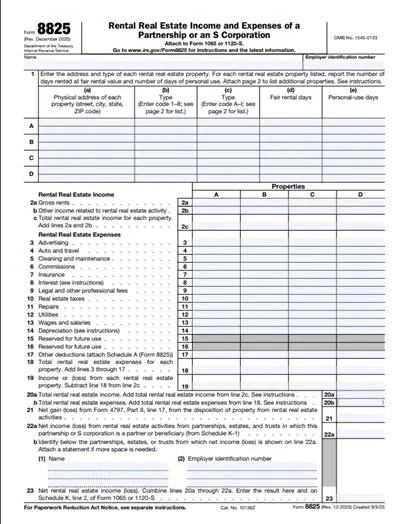
Form 8825 is organized by property. Each property is reported in its own column.
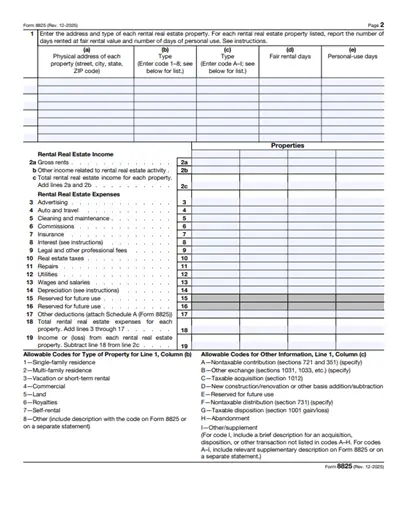
Each form has room for four properties (columns A through D) on the first page, with a second page available for four more (E through H). If your entity owns more than eight properties, attach additional copies of the form.
Step 1: Property information (Line 1)
For each property, enter:
- Physical address: street, city, state, and ZIP code
- Type of property: a short code identifying what kind of property it is (single-family, multi-family, vacation/short-term rental, commercial, land, royalties, self-rental, or other)
- Other codes (column c): new for the December 2025 revision: codes identifying gain-or-loss transactions tied to the property, such as a non-taxable contribution, taxable acquisition or disposition, new construction, or abandonment
- Fair rental days and personal-use days: only relevant if a property has any personal use, since that triggers the Section 280A expense allocation rules
Step 2: Report Rental Income (Lines 2a–2c)
Report gross rents received for each property on Line 2a. Under the current revision, non-rent income – reimbursements, fees, amenity income – goes on Line 2b instead of being folded into gross rents. Line 2c is the total (2a + 2b), calculated separately for each property.
Step 3: Report Rental Expenses (Lines 3–17)
Complete lines 3 through 17 for each property, covering the standard categories: advertising, auto and travel, cleaning and maintenance, commissions, insurance, legal and other professional fees, interest, repairs, taxes, utilities, and wages and salaries. Line 14 is depreciation, tied to Form 4562. Line 17 is “other deductions” – expenses that don’t fit the listed categories. If Line 17 is non-zero, attach the new Schedule A (Form 8825) itemizing what’s included, as covered above.
Step 4: Calculate Total expenses and net income per property (Lines 18–19)
For each property individually:
- Line 18: total expenses (sum of lines 3–17)
- Line 19: net income or loss for that property (Line 2c minus Line 18)
Step 5: Complete the Overall Totals
Lines 20a through 23 are completed only once on page 1, even if you’re using multiple copies of Form 8825 for more than four properties:
- Line 20a: total rental real estate income, combining Line 2c across all properties
- Line 20b: total rental real estate expenses, combining Line 18 across all properties
- Line 21: net gain (loss) from Form 4797, Part II, line 17, from the disposition of any rental real estate during the year
- Line 22a: net income (loss) from rental real estate activities passed through from other partnerships, estates, or trusts in which your entity is a partner or beneficiary (rare for most filers; skip if not applicable)
- Line 22b: names and EINs of the partnerships, estates, or trusts reported on Line 22a
- Line 23: combine lines 20a through 22a. This is your net rental real estate income (loss) for the year
Step 6: Carry the Rental Income or Loss to Schedule K
Enter the Line 23 total on Schedule K, line 2 of Form 1065 or Form 1120-S. Your tax software (or preparer) will then allocate each partner’s or shareholder’s share to Schedule K-1, box 2.
Passive Activity Loss Rules: Why They Matter Here
Rental real estate is generally treated as a passive activity under Section 469, although there are important exceptions and special rules.
This matters most when a rental property produces a loss.
In general, passive losses may be limited in how they can offset other types of income. The rules are applied at the owner level, so the tax treatment of a partner’s or shareholder’s rental loss can depend on that owner’s individual circumstances.
For example, an owner may have a rental loss reported on Schedule K-1 but may not be able to use the entire loss against wages or other nonpassive income immediately.
Some exceptions can apply. One important exception involves taxpayers who qualify as real estate professionals and meet the applicable material participation requirements.
Because these rules can become complicated quickly, rental losses should be reviewed at both the entity and owner levels.
Common Mistakes to Avoid
Even a small reporting error can create problems when rental income flows through to multiple owners. Here are some common mistakes to watch for:
- Reporting rental income as ordinary business income
Rental real estate income should be reported through the appropriate rental real estate reporting process rather than simply being combined with unrelated trade or business income.
- Combining all rental-related income into gross rents
The revised Form 8825 separates gross rents on Line 2a from other rental-related income on Line 2b. Make sure your accounting records provide enough detail to support this separation.
- Reporting the wrong expenses
Not every payment associated with a property is automatically deductible.
Repairs, improvements, capital expenditures, interest, depreciation, and other costs can have different tax treatments. Your accounting records should clearly distinguish between them.
- Missing depreciation
Depreciation can be a significant rental property deduction. Make sure the depreciation reported on Form 8825 agrees with the applicable depreciation schedules and Form 4562 when required.
- Entering incorrect totals
When multiple properties are reported, make sure the totals on Lines 20a through 23 include the amounts from all applicable pages.
The IRS specifically requires these totals to be completed once on page 1.
- Ignoring passive activity rules
A rental loss reported on Schedule K-1 does not necessarily mean the owner can deduct the entire loss immediately.
The owner’s individual passive activity situation needs to be considered.
- Missing related-party rental issues
If a rental property is leased to a related business, review the self-rental rules before completing the return.
- Not providing enough detail for other deductions
If your entity has a Schedule M-3 filing requirement, make sure the information needed for Schedule A (Form 8825) is available.
Good bookkeeping throughout the year makes this much easier.
Frequently Asked Questions
Does a single-member LLC file Form 8825?
No. A single-member LLC that is treated as a disregarded entity for federal income tax purposes generally reports its rental activity on the owner’s tax return instead.
Can Form 8825 income offset ordinary losses elsewhere on the return?
Not automatically. Rental real estate is generally subject to the passive activity rules. Those rules can limit how rental losses are used against nonpassive income. However, exceptions and special rules may apply depending on the owner’s circumstances.
What if the entity owns more than eight rental properties?
Additional Form 8825 pages can be attached as needed. Complete Lines 1 through 19 for each property. The overall totals on Lines 20a through 23 are completed only once on page 1.
Is Schedule A (Form 8825) required every year?
No. Schedule A is specifically used by partnerships and S corporations that are required to file Schedule M-3 to provide detail about other deductions. Entities that do not have a Schedule M-3 filing requirement generally report other deductions directly on Line 17.
Does Form 8825 include depreciation?
Yes. Depreciation for rental real estate is reported on Line 14. Form 4562 may also need to be completed and attached, depending on the circumstances.
Can interest expense be limited?
Yes. Section 163(j) may limit the amount of business interest expense that can be deducted in certain situations. The IRS directs taxpayers to the Form 8990 instructions when determining whether the limitation applies.
Before You File
Form 8825 may look straightforward, but accurate reporting requires more than simply entering rent and expenses.
The information on the form affects the entity’s tax return and ultimately flows through to its partners or shareholders. Errors in rental income, expenses, depreciation, property information, or passive activity reporting can therefore create problems beyond the Form 8825 itself.
The best way to make the process easier is to keep property-level accounting records throughout the year. Separate each property’s income and expenses, maintain accurate depreciation schedules, track related-party transactions, and keep supporting documentation for significant deductions.
For partnerships and S corporations with multiple rental properties, accurate bookkeeping and expert-led tax preparation processes can make Form 8825 reporting much more efficient and reduce the risk of errors.
Need help managing rental property accounting and tax-ready financial records? KnowVisory Global can support your accounting, bookkeeping, reconciliation, and financial reporting needs so your finance team has accurate information ready for tax preparation. Connect with us today for expert help!