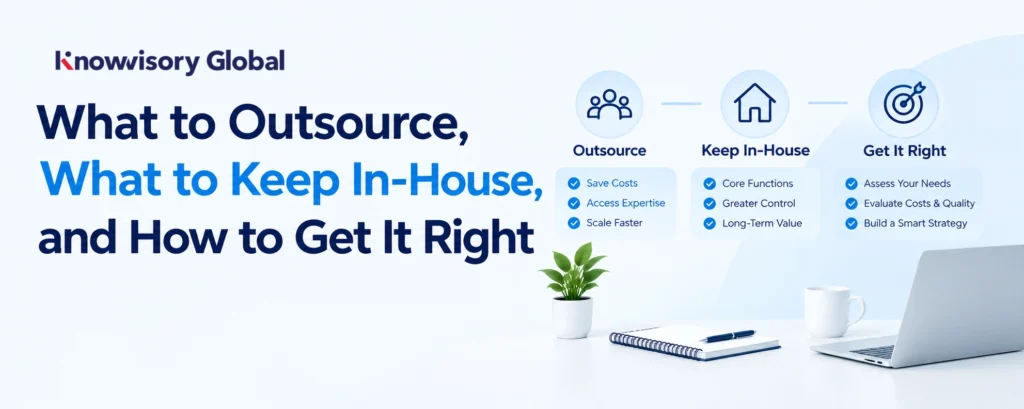
That is why outsourced bookkeeping for CPA firms has become a practical way to create capacity without adding another layer of fixed payroll. But outsourcing does not mean handing over the entire accounting function.
For many CPA firms, the more effective approach is to divide responsibilities: outsource repeatable, process-driven accounting work while keeping client ownership, professional judgment, final review, and strategic decision-making in-house.
A simple rule is: outsource execution; retain judgment.
Done well, this creates a more flexible delivery model without giving up control of the client relationship or the quality of the work.
What Should CPA Firms Outsource?
Not every accounting task requires a CPA’s direct involvement. Many bookkeeping activities are recurring, process-driven, and can be performed using established procedures, technology, and review controls.
These are often good candidates for outsourcing.
- Day-to-Day Bookkeeping
Transaction categorization, maintaining ledgers, recording routine transactions, and keeping accounting records current can consume significant staff time. An outsourced bookkeeping team can handle these activities according to the CPA firm’s processes and client-specific requirements.
The CPA firm’s internal team can then focus on reviewing the output and addressing exceptions rather than completing every transaction themselves.
- Routine Bank and Credit Card Reconciliations
Regular reconciliation is essential for maintaining accurate books, but routine reconciliations can also be repetitive and time-consuming. An external accounting team can reconcile bank and credit card accounts, identify discrepancies, investigate unmatched transactions, and flag exceptions for review.
The CPA or senior accounting professional can step in when an issue requires professional judgment, additional client information, or a more complex investigation.
- Accounts Payable and Accounts Receivable Support
Accounts Payable (AP) and Accounts Receivable (AR) services can also be delegated. The CPA firm can retain oversight while the external team manages the day-to-day processing.
- Month-End Close Support
Month-end close can put considerable pressure on accounting teams, particularly when several clients have different reporting deadlines. An outsourced team can support activities such as:
- Reconciliations
- Journal entry preparation
- Account reviews
- Balance sheet schedules
- Supporting documentation
- Preliminary financial statement preparation
The CPA firm’s team can then review the completed close, investigate exceptions, and address items requiring professional judgment.
- Catch-Up and Cleanup Bookkeeping
Historical cleanup can be especially resource-intensive. A client may come to a CPA firm with months—or even years—of incomplete reconciliations, uncategorized transactions, or inaccurate account balances.
Instead of pulling internal staff away from higher-value work, CPA firms can use outsourced catch-up bookkeeping services to work through the backlog under defined procedures and review requirements.
This can be particularly useful when a firm needs to bring a client’s books up to date before tax preparation, financial reporting, or advisory work.
What Should Stay In-House?
While many bookkeeping activities can be outsourced, certain responsibilities are closely tied to the CPA firm’s client relationship, professional expertise, and accountability. These are generally better retained internally.
- Client Relationships
The CPA firm should remain the primary owner of its client relationships, even when an external team handles part of the accounting workload.
Clients often rely on their CPA for more than accurate books. They expect someone who understands their business, history, financial objectives, and broader accounting and tax needs.
An outsourced team can support the delivery of accounting work, but responsibility for client expectations, escalations, and strategic conversations should remain clearly defined within the CPA firm.
- Tax Strategy and Professional Judgment
Tax planning requires an understanding of the client’s broader financial and business situation.
Decisions involving tax strategy, complex transactions, entity structure, and significant accounting or tax implications should remain with appropriately qualified professionals within the CPA firm.
The outsourced bookkeeping team can provide clean, organized financial information that helps the CPA make those decisions.
- Complex Accounting Decisions
Not every accounting issue is routine. Questions involving unusual transactions, complex revenue recognition, significant estimates, technical accounting matters, or industry-specific requirements may require senior-level expertise.
These decisions should remain under the CPA firm’s control, with the external team providing supporting information and documentation where appropriate.
- Final Review and Approval
Outsourcing the work does not necessarily mean outsourcing accountability.
The CPA firm may want to retain responsibility for reviewing financial information before it is finalized or delivered to the client.
An external accounting team can prepare the work, complete defined quality checks, and flag exceptions, while the firm’s senior professionals perform the final review and approval.
- Client Communication and Escalations
Not every client question needs to be handled by the CPA personally. However, firms should establish clear boundaries around what an external team can communicate directly and which matters must be escalated.
Sensitive issues, unresolved discrepancies, scope discussions, significant financial matters, and questions requiring professional judgment should have a clearly designated owner within the CPA firm.
The goal is not to keep every interaction in-house. It is to keep ownership and escalation authority clear.
- Advisory Services
This is where CPA firms can create significant value for clients.
Once routine bookkeeping is handled efficiently, internal professionals can spend more time discussing:
- Cash flow
- Profitability
- Business performance
- Forecasting
- Budgeting
- Tax planning
- Growth decisions
- Financial strategy
The objective is not simply to complete bookkeeping faster. It is to create more room for work that requires the CPA firm’s expertise and client knowledge.
A Simple Way to Divide the Work
| Keep In-House | Consider Outsourcing |
|---|---|
| Client relationships | Day-to-day bookkeeping |
| Tax strategy | Transaction categorization |
| Complex accounting decisions | Bank reconciliations |
| Final review and approval | Credit card reconciliations |
| Client escalations | AP/AR processing |
| Advisory services | Month-end close support |
| Technical consultations | Catch-up bookkeeping |
| Business-specific judgment | Routine reporting preparation |
| High-level financial decisions | Supporting schedules and documentation |
This, however, is not a rigid division. The right allocation depends on your services, client requirements, internal capabilities, technology stack, and agreement with the accounting partner.
Some firms may choose to outsource more of the accounting process, while others may retain additional review or client-facing responsibilities internally.
The important thing is to define who owns each task, who reviews it, and when an issue needs to be escalated.
How to Outsource Without Losing Control
Outsourcing works best when the external team operates within a clearly defined framework.
- Start Small. Pilot the model with a limited group of clients before moving a larger portion of your book of business. Starting with 5 to 10 clients can help your team identify workflow gaps, refine SOPs, and establish realistic turnaround times before expanding.
- Define Clear SOPs. Document coding rules, naming conventions, reconciliation procedures, close timelines, approval workflows, and escalation requirements. The more clearly the process is documented, the less room there is for inconsistent execution.
- Standardize Your Software. Use a consistent cloud accounting stack wherever possible, such as QuickBooks Online or Xero, along with tools such as Bill.com or Dext.
- Define clear deadlines and responsibilities. For example, the external team may be responsible for completing books by business day 8, followed by an internal quality check and review. Both sides should know who owns each step and what happens when a deadline or requirement is missed.
- Check Security Credentials. Before selecting an accounting partner, understand how they protect client information. Ask about relevant security controls, encryption, multi-factor authentication, access management, data handling procedures, confidentiality agreements, and available security documentation or reports.
Security requirements should also be aligned with the firm’s own policies and client obligations.
- Review Every Deliverable. Outsourcing should not eliminate quality control.
Sample-check work during the initial phase, then maintain a regular in-house review cycle. Review procedures should focus on accuracy, completeness, client-specific requirements, and recurring error patterns.
- Maintain Regular Communication. A weekly or monthly check-in with your provider can help surface issues before they become larger problems. Discuss upcoming deadlines, recurring errors, process changes, client-specific requirements, and workload capacity. Good communication is particularly important during tax season and other high-volume periods.
Common Mistakes to Avoid
- Outsourcing Without a Review Process. This is one of the biggest risks. Errors can reach clients under the CPA firm’s name if there is no defined review and escalation process.
- Choosing on Price Alone. A lower hourly rate does not necessarily mean a lower total cost. Consider accuracy, turnaround times, communication, security, review requirements, and the amount of internal oversight the provider requires.
- Skipping the Training Period. An external team needs time to understand your firm’s standards, client requirements, accounting policies, and technology stack. A structured onboarding period can reduce errors and improve consistency.
- Leaving Communication Expectations Unclear. Define who communicates with the client, what the external team can discuss, and when an issue must be escalated to the CPA firm. Clear ownership prevents confusion for both the client and the internal team.
- Treating Outsourcing as a Replacement Strategy. Outsourcing does not have to mean replacing internal accounting professionals. A more sustainable approach is to remove repetitive workload so internal staff can spend more time on review, client service, technical accounting, and advisory responsibilities.
The Potential Payoff: More Capacity, Better Margins, More Time for Clients
When the division of work is structured properly, CPA firms can create meaningful operational benefits:
- Lower delivery costs compared with maintaining equivalent in-house capacity
- More clients handled without proportional hiring
- Faster month-end close
- Less pressure on internal teams during busy season
- More time for advisory and higher-value work
- Greater flexibility to manage fluctuations in client workload
The value of outsourcing is not simply the cost of completing individual bookkeeping tasks. It is the capacity it can create across the firm’s entire delivery model.
Scale Your CPA Practice with Confidence Through Outsourced Bookkeeping Support
The question is not simply, “Should we outsource bookkeeping?”
A better question is: “Which parts should we outsource, and which should we protect?”
Keep client ownership, professional judgment, final review, complex accounting decisions, and advisory work close to the firm. Delegate repeatable, process-driven accounting work to a trusted partner with clear SOPs, review controls, security practices, and escalation procedures.
The goal is not to outsource everything. It is to build a deliberate division of work that allows your firm to increase capacity while maintaining control over quality and client relationships.
Ready to Create More Capacity Without Adding Fixed Headcount?
KnowVisory Global supports CPA firms with day-to-day bookkeeping, bank and credit card reconciliations, AP/AR support, month-end close, and catch-up bookkeeping.
Our team works as an extension of your firm, following defined workflows and review processes while your professionals retain client ownership, final review, and professional judgment. Partner with us and extend your firm’s bookkeeping capacity without expanding your in-house team.