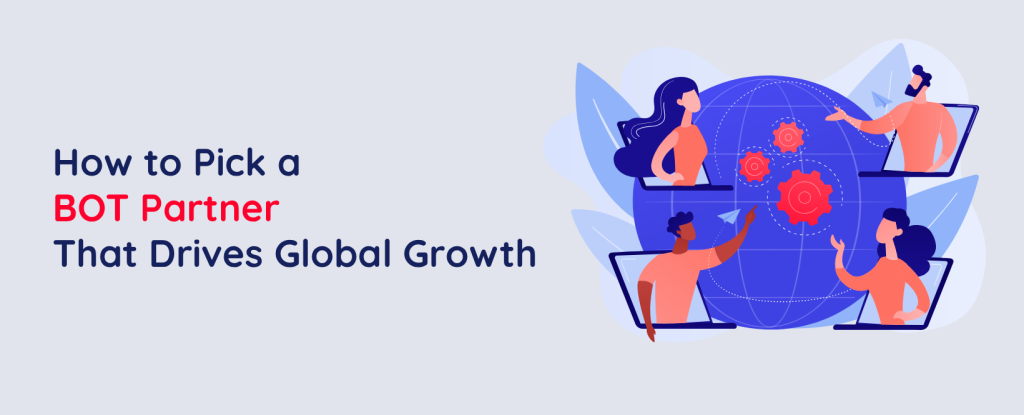

BOT for Global Expansion: When It Works Best (and Why)
When you run a business, expansion comes naturally. New customers, bigger opportunities, and higher growth potential – that’s obviously on the wish list of every U.S. business owner. But building a bigger brand means bigger teams. And that’s where the challenges begin. Finding the right talent is tough. Infrastructure and training costs quickly add up. And maintaining control over operations while trying to scale is not easy. Traditional outsourcing often looks like the most convenient solution, but it comes with trade-offs. More than 70% U.S. companies outsource at least some parts of their operations, yet many remain dissatisfied with the outcomes. The reasons are clear: 38% struggle with communication barriers due to time zones and language gaps (Gartner) 30% find managing outsourced teams difficult, often facing delays and misalignment (Deloitte) 25% worry about data security, raising compliance and confidentiality concerns (Forbes) 20% encounter hidden costs (McKinsey) 15% companies experience delays due to unclear goals and expectations (HubSpot) This growing dissatisfaction is fueling change. A BCG report found that roughly 62% of businesses are planning to renegotiate outsourcing contracts, rethinking the terms, pricing structure, and service delivery models. In other words, while outsourcing remains widespread, many companies are actively seeking smarter, more balanced alternatives. That’s why, today, most U.S. business owners are turning to the Build-Operate-Transfer (BOT) model — a smarter, more controlled way to expand into new markets while keeping your brand standards intact. Think of it as Outsourcing 2.0 – where you get the speed and flexibility of outsourcing while still ending up with your own dedicated team, systems, and control. What is the BOT Model in Simple Terms? BOT (Build-Operate-Transfer) is a business expansion model where you partner with a specialized firm to: Build – Set up the infrastructure, hire local talent, and get your offshore/nearshore operations running. Operate – The partner manages daily operations for a fixed period while you focus on growth. Transfer – After the agreed timeline, ownership of the entire setup – people, processes, and technology – is handed over to you. With the help of a specialized service provider, you get a fully-functional, highly compliant team that’s ready to deliver from day one – without the growing pains of hiring resources or setting up the process alone. Did You Know? India’s Global Capability Centers (GCC) market is on a strong growth path. It is expected to nearly double by 2030. According to Reuters, the sector is forecasted to expand from $64.6 billion in FY 2024 to between $99 billion and $105 billion by 2030.” When Does BOT Make the Most Sense? The BOT model is particularly useful in situations where: 1. When Speed Matters, But Control Matters Too If your company needs to scale operations quickly to meet growing client demand, outsourcing gets you there fast. But you have to share your data and long-term strategy with a vendor. With BOT, you can quickly set up your offshore team through a trusted partner. But since the operation will eventually be yours, you’re not outsourcing your back office operations, but building a dedicated offshore team that follows your processes, maintains your standards, and eventually transitions fully under your control. 2. When You Want to Test a New Market Before Committing New markets are unpredictable. Labor laws, tax structures, cultural fit, even customer behavior can surprise you. BOT gives you a low-risk way to test the waters without heavy upfront costs. Instead of incorporating a new entity, you leverage your partner’s infrastructure. If the market proves viable, you transfer operations to your ownership. If not, you can exit without major sunk costs. 3. When Talent is Scarce (and Expensive) Locally Local hiring can be costly and time-consuming, especially around specialized roles in accounting and bookkeeping, where there’s already a shortage of talent. BOT helps you access skilled talent in global markets at a fraction of the cost, without compromising on quality or compliance. 4. When Compliance & Regulations Are Complex Global expansion often comes with a minefield of compliance rules: GDPR in Europe, payroll regulations in Asia, local employment laws, tax frameworks, and more. BOT providers are already set up to handle this. They bring local expertise and are fully compliant with local laws. They ensure you stay compliant from day one. And once you’re ready, you inherit a fully compliant operation rather than figuring it out from scratch. 5. When You Want Cost Efficiency Without Vendor Lock-in Traditional outsourcing often feels like a subscription – you keep on paying the vendor without ever owning the asset. BOT flips that script. Yes, the upfront costs may be higher than simple outsourcing, but in the long term, you end up with a fully-owned, cost-efficient operation. It’s an investment, not just an expense. 6. When You’re Planning for Long-Term Global Presence If your goal is just short-term cost savings, outsourcing might do the job. But if you’re building a long-term global footprint, BOT is a smarter expansion strategy. Why? Because the model is designed for scalability. Once the transfer is complete, you can expand operations further without re-negotiating vendor contracts. So, whether you want to test a market, mitigate compliance risks, or plan a permanent footprint, BOT offers a safer, smarter path to global expansion. Advantages of BOT Over Traditional Outsourcing Here’s how the Build-Operate-Transfer (BOT) model gives U.S. firms a clear edge compared to traditional outsourcing: Full Ownership After Transfer With BOT, the offshore finance and accounting team eventually becomes your team — trained in your processes, culture, and compliance standards. Outsourcing, on the other hand, keeps you dependent on a vendor indefinitely. Greater Control and Transparency BOT gives you full visibility into how work is delivered. You define the workflows, tools, and quality standards. Outsourcing vendors usually run operations their way, limiting your influence. Long-Term Cost Efficiency While outsourced accounting and bookkeeping services may look cheaper at first, costs can rise with vendor markups and renewals. BOT reduces overhead in the long run, as you end up owning the team, setting up the resources, without recurring